Introduction: Fashion Has a Visualization Problem
Fashion has always been visual.
From touching fabrics in stores to watching garments on a runway, buying decisions depend on how products look and feel.
But online fashion changed everything.
How do customers understand a garment when they only see a flat image?
This gap creates real challenges for brands:
- Low buyer confidence
- High return rates
- Poor conversions despite good designs
- Difficulty visualizing finished garments from fabric
Textile AI was built to solve this exact problem — not just partially, but across the entire fashion journey.
The Beginning: A Real Problem Observed During Diwali
Every strong product starts with a real-world problem.
During Diwali — when fashion demand peaks — a clear issue appeared across boutiques, designers, and fabric sellers.
There was no shortage of beautiful fabrics:
- Silk
- Cotton
- Rayon
- Printed textiles
- Ethnic and modern materials
But one question kept repeating:
“How will this fabric look after stitching?”
Designers struggled to explain it.
Customers hesitated to buy.
This wasn’t a design issue — it was a visualization gap.
That moment became the starting point of Textile AI.
Phase One: Fabric-to-Garment AI
The first goal was simple:
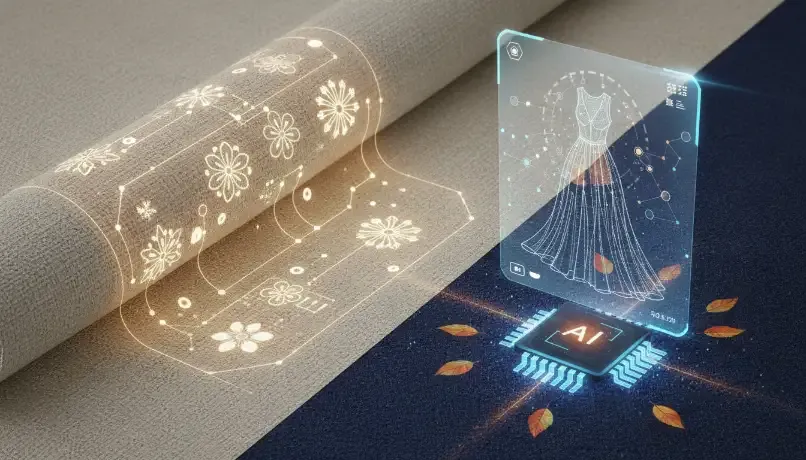
Convert fabric into realistic garment visuals using AI.
With Textile AI, users could:
- Upload a fabric image
- Select a garment type
- Instantly generate a stitched design
This changed how businesses operate:
- Designers present ideas faster
- Fabric sellers show ready designs
- Boutiques reduce dependency on samples
It solved the first major problem — but not the last.
The Turning Point: Design Alone Is Not Enough
Even with realistic designs, one question remained:
What happens after the design is ready?
Fashion is not just about creating garments.
It’s about helping customers make decisions.
Customers don’t just want to see clothes —
they want to see themselves wearing them.
That insight changed everything.
The Evolution: Why Virtual Try-On Was Necessary
If AI can already:
- Understand fabric textures
- Generate garments
- Simulate draping
Then the next step is obvious:
Help customers visualize:
- Fit
- Look
- Confidence
This led to the evolution of Virtual Try-On.
Virtual Try-On: From Imagination to Confidence
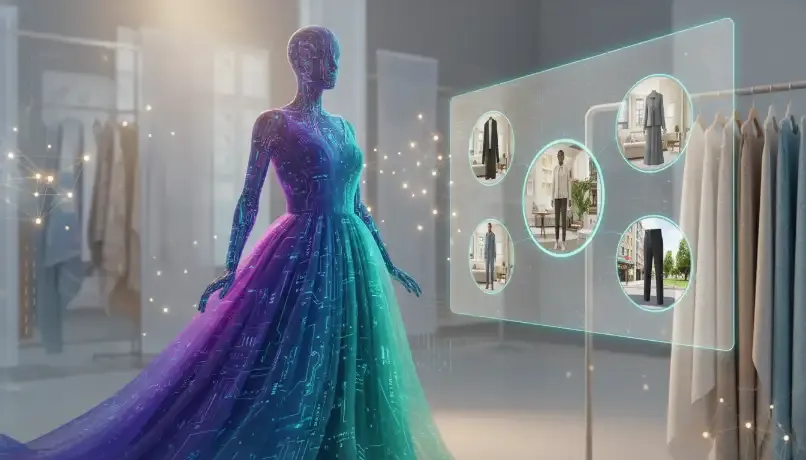
Virtual try-on allows customers to:
- See outfits on digital models
- Understand how garments look before buying
- Reduce hesitation
For fashion brands, this directly improves:
- Customer confidence
- Conversion rates
- Add-to-cart actions
- Return reduction
Virtual try-on is not a trend —
it’s a decision-making tool.
Complete Flow: From Fabric to Final Purchase
Textile AI now supports an end-to-end journey:
1. Fabric Upload
Raw textile image input
2. Garment Visualization
AI creates stitched designs
3. Design Variations
Different styles and patterns
4. Virtual Try-On
Garments shown on models
5. Customer Understanding
Clear product visualization
6. Purchase Decision
Faster and more confident buying
This complete flow is what makes Textile AI unique.
Why Fashion Brands Are Adopting This Model
Across global markets, fashion brands face similar issues:
- Customers can’t try products
- Returns are expensive
- Photoshoots are costly
- Product launches take time
Textile AI helps solve these by enabling:
- Faster collection launches
- Reduced production costs
- Better customer trust
- Scalable visual content
It is valuable for:
- Boutique owners
- D2C brands
- Ecommerce stores
- Textile exporters
The Core Philosophy
Textile AI follows a simple principle:
Solve real problems first. Technology comes second.
This approach shaped every feature:
- Fabric visualization
- Garment generation
- Virtual try-on
- Continuous improvements
Growth: From Diwali Idea to Global Platform
Textile AI continues to evolve based on:
- User feedback
- Industry needs
- Real fashion workflows
Ongoing improvements include:
- More garment categories
- Better realism
- Faster processing
- Ecommerce integrations
Impact on Ecommerce Performance
Better visualization directly improves business results.
Brands using AI-based visualization see:
- Higher engagement
- Better product understanding
- Increased conversions
- Reduced returns
Virtual try-on is quickly becoming a standard expectation.
Future of Fashion Visualization
Fashion ecommerce is moving beyond static images.
The future includes:
- AI-generated visuals
- Interactive experiences
- Personalized previews
- Smart styling suggestions
Textile AI is already aligned with this direction.
Conclusion
Textile AI is more than just a tool.
It connects:
- Fabric → Design
- Design → Visualization
- Visualization → Purchase
From a simple Diwali idea to a growing global platform, the goal remains the same:
Help fashion brands present better, sell faster, and grow confidently.