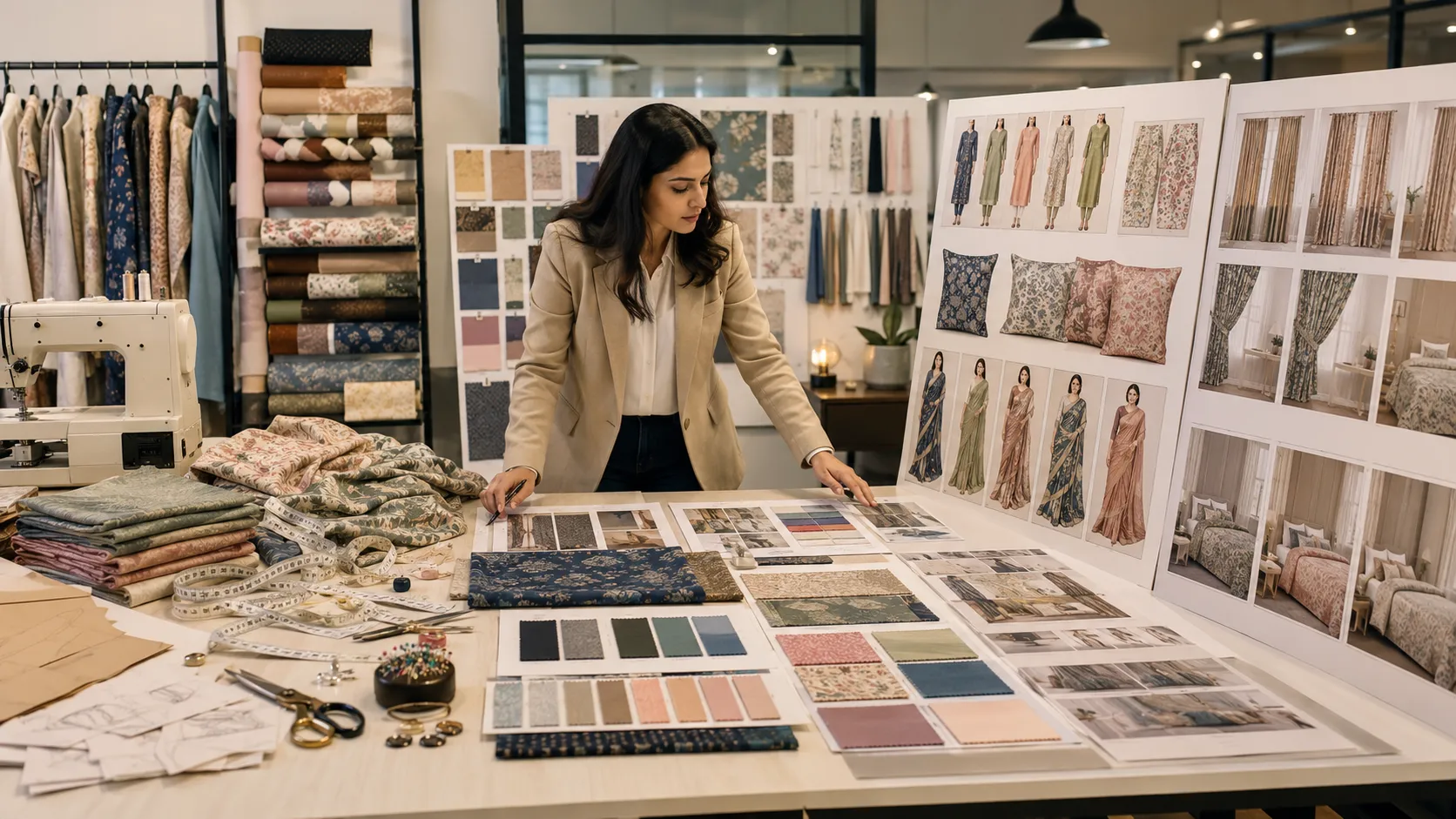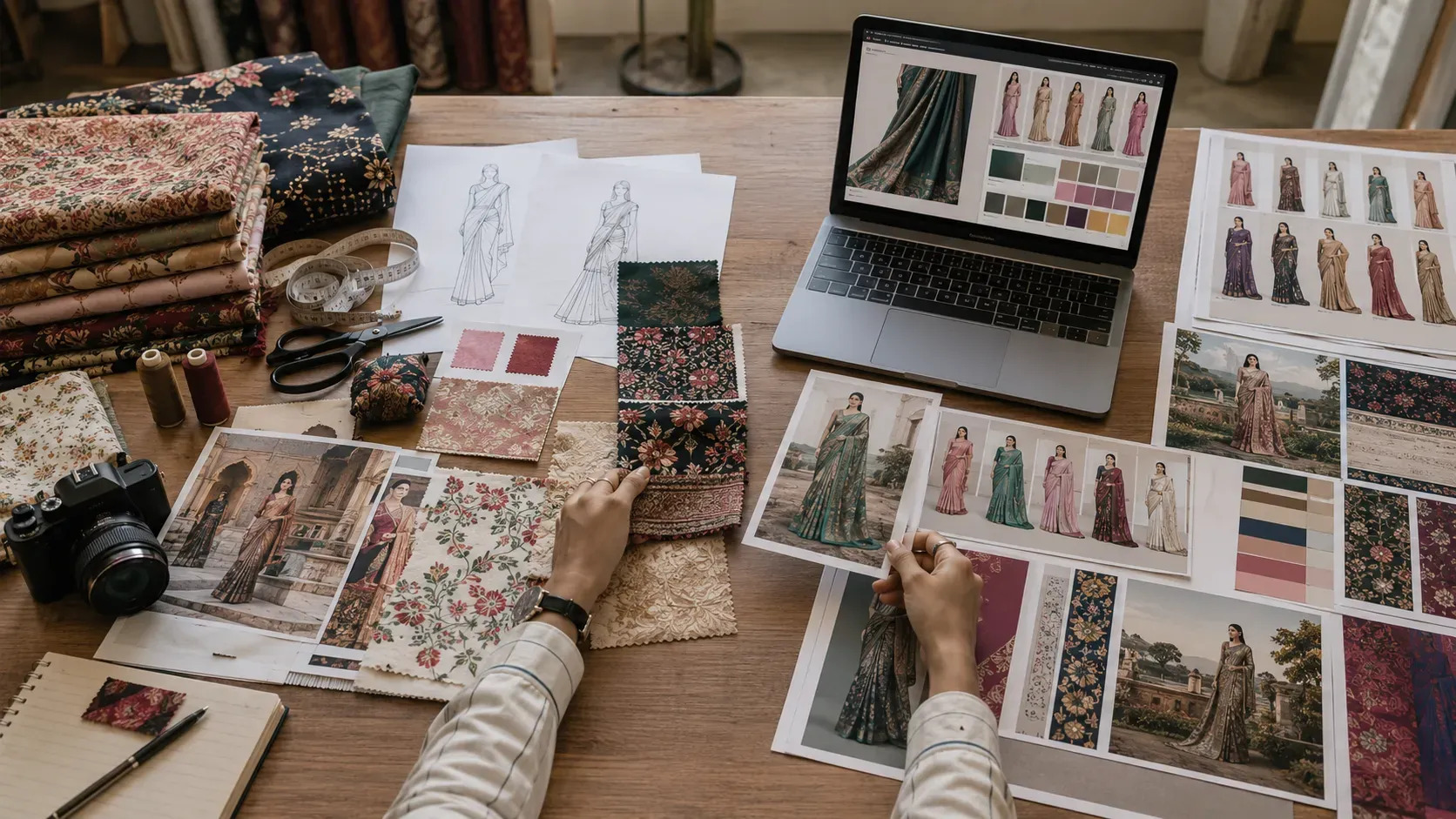
The textile industry has always depended on creativity, craftsmanship, fabric knowledge, and strong product presentation.
A good textile business does not only create fabric. It also needs to show how that fabric can become a garment, a saree, a catalog image, a home textile product, a campaign banner, or a complete fashion collection.
Traditionally, this process has been slow.
A team may start with a fabric design or swatch. Then they may create physical samples, stitch garments, arrange model photoshoots, prepare product mockups, edit images, build catalogs, create banners, make videos, and finally publish the product online.
This workflow can produce strong results, but it takes time, money, and coordination.
Now AI textile design tools are changing this workflow.
AI tools help textile and fashion businesses create product visuals faster. They can convert fabric into garment previews, generate catalog-ready product images, create AI fashion photoshoots, show garments on models, generate saree catalog images, create videos, make banners, generate color variants, and improve image quality.
This does not mean traditional textile work is no longer useful.
Fabric knowledge, design sense, sampling, stitching, production, and quality checking are still important. But AI helps reduce repeated manual work and makes visual presentation faster.
The Textile AI is built for this modern workflow. It brings multiple AI tools together for textile design, product visualization, fashion content, catalog creation, and marketing.
Website:
https://www.thetextileai.com/
What Are AI Textile Design Tools?
AI textile design tools are digital tools that use artificial intelligence to support textile design, fabric visualization, product mockups, catalog creation, fashion photoshoots, and marketing content.
In simple words, they help convert textile ideas into visual outputs faster.
A fabric swatch can become a garment preview. A garment image can become a model-worn product photo. A saree image can become a draped catalog visual. A product image can become a banner. A design can become a color variant. A fashion product can become a video ad.
Earlier, these tasks needed different teams, different software, physical samples, photoshoots, manual editing, and long approval cycles.
AI tools make the process more direct.
They help brands test ideas, create visuals, and present products before spending too much time on physical production.
“AI textile design tools do not replace textile creativity. They help textile creativity become visible faster.”
What Are Traditional Textile Workflows?
Traditional textile workflows usually move step by step.
A designer creates a design. The fabric is printed or woven. A sample is created. The product is stitched. The garment or textile item is photographed. The images are edited. Catalogs are made. Marketing assets are prepared. Then the product is launched.
This process has worked for many years because it gives real-world output. Teams can touch the fabric, check the fall, test stitching, inspect quality, and approve production.
But the problem is speed.
If a brand wants to test many fabric designs, traditional workflows can become slow. If the team wants to create product photos for many SKUs, photoshoots become expensive. If the business needs catalog images, social media content, banners, and videos for every launch, the workload becomes heavy.
Traditional workflows are still important for final production and quality approval.
But they are not always efficient for early visual testing, product previews, marketing drafts, and large-scale catalog content.
Remember: Traditional textile workflows are strong for final production, but they can be slow for fast visual creation.
The Main Difference Between AI Tools and Traditional Workflows
The biggest difference is how quickly a textile idea becomes a visual.
In a traditional workflow, a fabric may need to become a physical sample before buyers can understand its final use. In an AI workflow, the same fabric can be digitally shown as a garment, product mockup, catalog image, or campaign visual much earlier.
This changes the speed of decision-making.
A textile seller can show buyers fabric possibilities faster. A fashion brand can test garment styles before stitching. A saree seller can create model-worn catalog images from raw saree assets. A home textile brand can preview curtains, cushions, table runners, and sofa throws before making every sample physically.
AI does not remove the need for real production.
It helps teams decide what should move into production.
“Traditional workflows create the final product. AI workflows help teams decide the right product faster.”
Fabric to Garment AI vs Physical Sampling
Fabric to Garment AI helps textile businesses show fabric as finished garments or product mockups.
In a traditional workflow, a seller may need to cut fabric, stitch a kurti, shirt, blazer, t-shirt, or sample product, then photograph it before showing the buyer. This takes time and cost.
With AI, the seller can upload a fabric image and preview it as a finished garment. The fabric can be shown on model-based outputs or product mockups depending on the requirement.
This is useful because buyers often need to see the final product possibility.
A flat fabric photo may not be enough. A fabric may look ordinary as a swatch but attractive as a kurti. A print may work better on a shirt than on a blazer. A home textile fabric may look better as curtains or cushion covers.
AI helps test these directions visually.
Physical sampling is still needed for final approval, fabric feel, stitching, fit, and production quality. But AI can reduce unnecessary first-round sampling.
Tip: Use Fabric to Garment AI before creating physical samples so your team can shortlist stronger product ideas faster.
AI Catalog Generator vs Manual Catalog Creation
Catalog creation is one of the most important parts of fashion and textile selling.
A good catalog helps buyers understand the product clearly. It shows different views, styling, details, and product quality.
Traditional catalog creation usually needs a model, photographer, studio, lighting, styling, editing, and formatting. If a brand has many products, the catalog process becomes expensive and slow.
AI catalog generation helps create catalog-ready product visuals faster.
A clothing brand can upload model and garment references and generate front, side, back, detail, and angled product images. This helps create product galleries for Shopify stores, buyer presentations, e-commerce pages, and product catalogs.
The biggest benefit is speed and consistency.
When product images follow similar lighting, framing, and model styling, the catalog looks more professional.
Remember: A strong catalog is not just a set of photos. It is a product presentation system.
Virtual Try-On AI vs Traditional Model Shoots
Virtual Try-On AI helps brands show garments on model photos without arranging a full model shoot every time.
In a traditional shoot, the brand needs the model, garment, studio, lighting, styling, photographer, and editing team. This works well for high-end campaigns, but it is not always practical for every product or every color variant.
Virtual Try-On AI makes product visualization faster.
A brand can upload a model photo and garment image, then generate a model-worn output. This is useful for e-commerce product pages, fashion previews, social media content, and catalog planning.
For online fashion stores, model-worn visuals are valuable because customers want to imagine the garment in use.
AI virtual try-on helps create that visual faster.
Traditional model shoots are still useful for brand campaigns and real-life product validation. But virtual try-on is useful when brands need more product visuals quickly.
“Virtual Try-On AI helps brands create model-worn product visuals without waiting for every full shoot.”
Fashion Photoshoot AI vs Studio Photography
Studio photography has always been important for fashion.
It creates real campaign images, brand stories, model looks, and premium product visuals. But studio photography needs planning and cost. A brand needs model booking, location, makeup, styling, lighting, photographer, editing, and approvals.
Fashion Photoshoot AI helps brands create high-end model visuals faster.
A clothing brand can use AI to create campaign-style product images, editorial looks, and fashion visuals without arranging every photoshoot physically.
This is useful for product launches, social media campaigns, ad creatives, website visuals, and seasonal collections.
AI fashion photoshoots are especially helpful when brands need many visual variations. A brand can test backgrounds, model styles, poses, moods, and campaign ideas before committing to a full shoot.
Studio photography is still valuable for final brand campaigns.
AI helps speed up the creative planning and content creation process.
Tip: Use Fashion Photoshoot AI to test campaign ideas before investing in a full production shoot.
AI Video Ads vs Traditional Video Production
Video content is becoming important for fashion and textile marketing.
Brands need videos for Instagram, YouTube Shorts, reels, ads, product launches, and website sections. Traditional video production can be expensive because it needs filming, editing, direction, models, lighting, and post-production.
AI Video Ads help brands create product showcase videos faster.
Instead of planning a full video shoot for every product, businesses can use AI to turn product visuals into short promotional videos. This is useful for product launches, social media ads, collection teasers, and e-commerce marketing.
For textile businesses, video helps show movement, mood, and product appeal.
A garment image can become a more engaging ad. A catalog visual can become a short promotional clip. A product campaign can get video content faster.
Traditional video production still matters for large campaigns, but AI video tools help brands create regular marketing content with less delay.
Remember: AI video tools are useful when brands need fast, frequent, product-focused content.
Saree Catalog Generator vs Traditional Saree Photoshoots
Saree catalog creation is one of the most detailed workflows in fashion photography.
A saree photoshoot needs correct draping, neat pleats, visible pallu, matching blouse, proper border placement, model styling, lighting, and editing. This takes skill and time.
For saree sellers with many products, traditional photoshoots can become expensive.
AI saree catalog generation helps create model-worn saree visuals from raw saree assets. A seller can upload a raw saree photo and optional references like blouse front, blouse back, zoomed pattern, and model reference. Then AI can generate catalog images in selected poses and aspect ratios.
This is useful for Shopify saree stores, Instagram sellers, boutiques, wholesalers, manufacturers, and ethnic wear brands.
AI helps sellers show the saree as a complete draped look, not only as folded fabric.
“A saree is not only fabric. It is a drape, a fall, a blouse, a pallu, and a complete visual emotion.”
Banner Generator vs Manual Campaign Design
Textile and fashion businesses need banners for websites, ads, seasonal campaigns, product launches, and category pages.
Traditional banner design requires product images, background design, layout planning, text placement, editing, and multiple revisions.
AI Banner Generator helps create campaign visuals faster.
A brand can generate banner-style visuals for product promotions, collection launches, website hero sections, and social media campaigns. This helps marketing teams create fresh visuals without waiting for every manual design cycle.
For online stores, banners are important because they create first impression.
A strong banner can make a collection look premium and ready to explore.
AI does not remove the need for design judgment, but it helps create more visual options quickly.
Tip: Use AI banners for fast campaign testing, then refine the best-performing direction for final marketing use.
Color Variant AI vs Manual Colorway Creation
Color variants are important in textile and fashion.
A buyer may like a design but want to see it in different shades. A fashion brand may need seasonal colorways. A textile seller may want to present multiple options to a client.
Traditionally, colorway creation can take manual editing, reprinting, sampling, or design software work.
AI Color Variant tools help generate multiple color versions faster.
A design can be shown in pastel tones, dark colors, festive shades, neutral palettes, or client-specific color combinations. This makes buyer presentations stronger.
Instead of showing only one color option, textile businesses can present more choices and improve approval chances.
Physical samples are still important for final color matching, but AI helps speed up early color discussion.
Remember: AI color variants help buyers compare faster before final production starts.
Image Upscale AI vs Manual Retouching
Product images need clarity.
A low-quality image can make a good product look weak. Textile and fashion products need sharp details because fabric texture, embroidery, prints, border work, and stitching are important.
Traditional retouching can improve images, but it takes editing time.
AI Image Upscale helps improve image quality faster. It can make product visuals sharper and more useful for catalogs, product pages, banners, and marketing materials.
This is helpful when businesses have older images, lower-resolution outputs, or visuals that need extra clarity before publishing.
For textile brands, image quality matters because customers and buyers judge fabric details visually.
Tip: Use Image Upscale AI when product visuals need better clarity for catalog or website use.
Advanced Fabric AI vs Manual Texture Simulation
Textile products depend on texture.
A fabric is not only about print. It may have weave, shine, thickness, embroidery, surface detail, matte finish, glossy finish, or structured texture.
Traditional texture simulation requires skilled design work and software.
Advanced Fabric AI helps create high-fidelity fabric textures, weaves, and finishes faster. This can support design development, fabric presentation, product visualization, and creative exploration.
For textile designers, this is useful because fabric finish changes product perception.
A design may look different on silk, cotton, linen, satin, denim, chiffon, or embroidered fabric. AI can help visualize these directions more quickly.
Traditional fabric development is still needed for real production, but AI helps teams explore visual options earlier.
Fabric to Product AI vs Physical Product Mockups
Fabric to Product AI helps turn raw fabric into final product mockups.
This is useful for home textiles, accessories, and product-focused textile businesses. A fabric can be shown as a cushion cover, curtain, table runner, table cloth, or other product item.
In a traditional workflow, a brand may need to create physical product samples before showing the final product. This takes time and material.
AI product mockups help businesses preview product applications faster.
This is useful for home decor brands, textile exporters, furnishing businesses, and online product sellers.
A fabric shown as a finished product can create better buyer understanding than a plain swatch.
“Fabric to Product AI helps buyers see what the material can become.”
Where Traditional Textile Workflows Still Matter
AI is powerful, but traditional textile workflows are still important.
Physical samples are needed to check real fabric feel, GSM, stitching quality, fit, color matching, shrinkage, drape, wash behavior, and production feasibility.
A digital image can show visual direction, but it cannot replace touch, hand feel, or real production testing.
Traditional photoshoots are also important for premium campaigns, celebrity shoots, influencer content, brand storytelling, and final luxury marketing.
So the best workflow is not AI only.
The best workflow combines AI and traditional methods.
Use AI for idea testing, visual previews, catalog drafts, buyer presentations, color exploration, and marketing content. Use traditional workflows for final product development, quality checking, production approval, and premium brand campaigns.
Remember: AI helps speed up the journey, but real textile expertise still controls the final product.
How AI Tools Reduce Sampling Time
Sampling takes time because every physical sample requires material, labor, stitching, finishing, review, and sometimes shipping.
AI tools help reduce sampling time by allowing businesses to preview ideas digitally first.
A team can test multiple garment styles, colorways, catalog looks, and product applications before creating physical samples. This helps them shortlist better options.
For example, a textile seller can first preview a fabric as a kurti, shirt, blazer, and cushion cover. A saree seller can generate model-worn drape visuals before arranging a photoshoot. A clothing brand can create catalog previews before booking a studio.
This helps reduce unnecessary first-round samples.
Tip: Use AI tools at the early stage, before spending money on physical samples.
How AI Tools Improve Buyer Presentations
Buyer presentations are stronger when they show finished possibilities.
A buyer may not fully understand a flat fabric swatch or rough sketch. But when the same design is shown as a garment, catalog image, product mockup, or lifestyle visual, the product becomes easier to understand.
AI tools help create polished visuals for buyer meetings, wholesale catalogs, export presentations, retailer decks, and online previews.
This can help sellers respond faster and look more professional.
When buyers see clear product possibilities, they can make decisions faster.
“A better visual presentation can make the same fabric feel more valuable.”
How AI Tools Help E-Commerce Brands
E-commerce brands need content all the time.
They need product images, collection images, banners, videos, social media posts, ads, catalog visuals, and product page galleries. Traditional content creation can become a bottleneck.
AI textile design tools help create these assets faster.
A Shopify fashion store can create product photos, model visuals, banners, and videos. A saree seller can generate draped catalog images. A home textile brand can create product mockups and lifestyle visuals. A clothing brand can create multi-angle catalog images.
This helps products go live faster.
For online stores, faster content creation can support faster selling.
Remember: E-commerce products cannot sell properly until the visuals are ready.
Cost Difference Between AI Tools and Traditional Workflows
Traditional workflows can be expensive because they require many resources.
Physical samples, models, photographers, studios, stylists, makeup artists, editors, designers, and shipping can increase cost.
AI tools reduce some of these repeated costs by creating digital previews and marketing visuals faster.
This does not mean AI has no cost. AI tools may use credits or subscriptions. But the cost is often easier to manage compared to repeated sampling and photoshoots.
For small businesses, AI can make professional visuals more accessible.
For large businesses, AI can reduce repetitive work and support scale.
Tip: Use AI for high-volume visual creation and save traditional production budgets for final approval and premium campaigns.
Speed Difference Between AI and Traditional Workflows
Speed is one of the biggest differences.
Traditional textile workflows can take days or weeks, especially when physical samples and photoshoots are involved.
AI tools can create visual outputs much faster.
This helps businesses respond quickly to buyers, test more ideas, prepare launch content, and reduce waiting time between design and presentation.
In fast-moving fashion and textile markets, speed matters.
A brand that can show product visuals faster can move decisions faster.
“In textile business, faster visual approval can lead to faster product launch.”
Quality Difference Between AI and Traditional Workflows
Quality depends on how the workflow is used.
Traditional workflows offer real-world accuracy because the product is physically created and photographed. This is useful for final selling, production approval, and brand campaigns.
AI workflows offer speed, flexibility, and scale. They are useful for previews, presentations, testing, catalogs, and marketing drafts.
The best quality comes when both work together.
AI can help create the first visual direction. Traditional methods can confirm the final product quality.
For example, a brand can use AI to test garment ideas and catalog styles. After selecting the best direction, it can create final physical samples and premium campaign photography.
Remember: AI helps create fast visual possibilities. Traditional workflows confirm real product quality.
Best Use Cases for AI Textile Design Tools
AI textile design tools can be useful across many parts of the textile and fashion workflow.
The most useful use cases include:
- Showing fabric as finished garments
- Creating AI catalog images
- Generating saree catalog images
- Creating virtual try-on outputs
- Producing AI fashion photoshoots
- Generating video ads
- Creating website banners
- Making color variants
- Upscaling product images
- Creating fabric-to-product mockups
- Preparing buyer presentation visuals
- Reducing early sampling
- Creating e-commerce product content
- Testing campaign ideas
These use cases make AI useful for designers, sellers, manufacturers, catalog teams, and marketing teams.
Common Mistakes to Avoid When Using AI Textile Tools
AI tools can create visuals quickly, but businesses should use them carefully.
One common mistake is using poor input images. If the fabric, garment, saree, or model reference is blurry or unclear, the output may not be accurate.
Another mistake is expecting AI to replace quality checking. Every AI output should be reviewed before publishing or sending to a buyer.
Businesses should also avoid vague instructions. Clear prompts help AI understand the product, mood, lighting, background, and important details.
The final mistake is using AI visuals without checking fabric accuracy. Textile products depend on color, pattern, border, embroidery, weave, and texture. These details must be reviewed carefully.
Tip: AI makes the workflow faster, but your brand’s eye for quality still matters.
How to Build a Smart AI + Traditional Textile Workflow
The best approach is to use AI and traditional workflows together.
Start with AI for early visualization. Upload fabric, garment, saree, or design references and create product previews. Use AI to test garment styles, catalog views, color variants, campaign banners, and buyer presentation visuals.
After that, shortlist the strongest ideas.
Then use traditional workflows for final sampling, quality checking, production approval, real photoshoots, and final campaign assets.
This gives businesses both speed and reliability.
AI helps teams move faster in the early stage.
Traditional methods confirm the final product.
“The smartest textile workflow uses AI for speed and traditional expertise for final quality.”
Why The Textile AI is Useful for Modern Textile Workflows
The Textile AI brings multiple AI tools together for textile and fashion businesses.
It includes tools for Fabric to Garment, Fashion Photoshoot, AI Video Ads, Virtual Try-On, Catalog Generator, Saree Catalog Generator, Banner Generator, Video Studio, Color Variant, Image Upscale, Advanced Fabric, Fabric to Product, and other product visualization workflows.
This makes it useful for many businesses.
A textile seller can show fabric as finished garments. A fashion brand can create product images and lookbooks. A saree seller can generate draped catalog visuals. A home textile brand can create product mockups. A Shopify seller can create product images, banners, and videos. A marketing team can create campaign visuals faster.
Instead of using separate tools for every visual task, businesses can create more of their textile content in one platform.
Website:
https://www.thetextileai.com/
The Future of Textile Workflows
The future of textile workflows will not be fully traditional or fully AI.
It will be a combination of both.
AI will help teams create visuals faster, test product ideas earlier, reduce sampling waste, prepare buyer presentations, and generate marketing assets. Traditional textile expertise will still guide fabric quality, production accuracy, physical sampling, stitching, finishing, and final approval.
This combination can make textile businesses more efficient.
Brands will be able to move from idea to market faster. Designers will be able to test more concepts. Sellers will be able to present products more clearly. E-commerce teams will be able to launch products with stronger visuals.
AI textile design tools will become a normal part of modern textile business workflows.
Final Thoughts
AI Textile Design Tools and traditional textile workflows both have value.
Traditional workflows are important for real production, fabric quality, stitching, sampling, and final campaign photography. AI tools are useful for speed, visualization, catalog creation, product mockups, buyer presentations, color variants, banners, videos, and e-commerce content.
The real advantage comes when both are used together.
AI helps businesses move faster from idea to visual. Traditional expertise helps confirm the final product.
For textile sellers, designers, saree brands, clothing brands, home textile businesses, Shopify stores, and catalog teams, this hybrid workflow can save time, reduce cost, and improve product presentation.
Explore The Textile AI here: