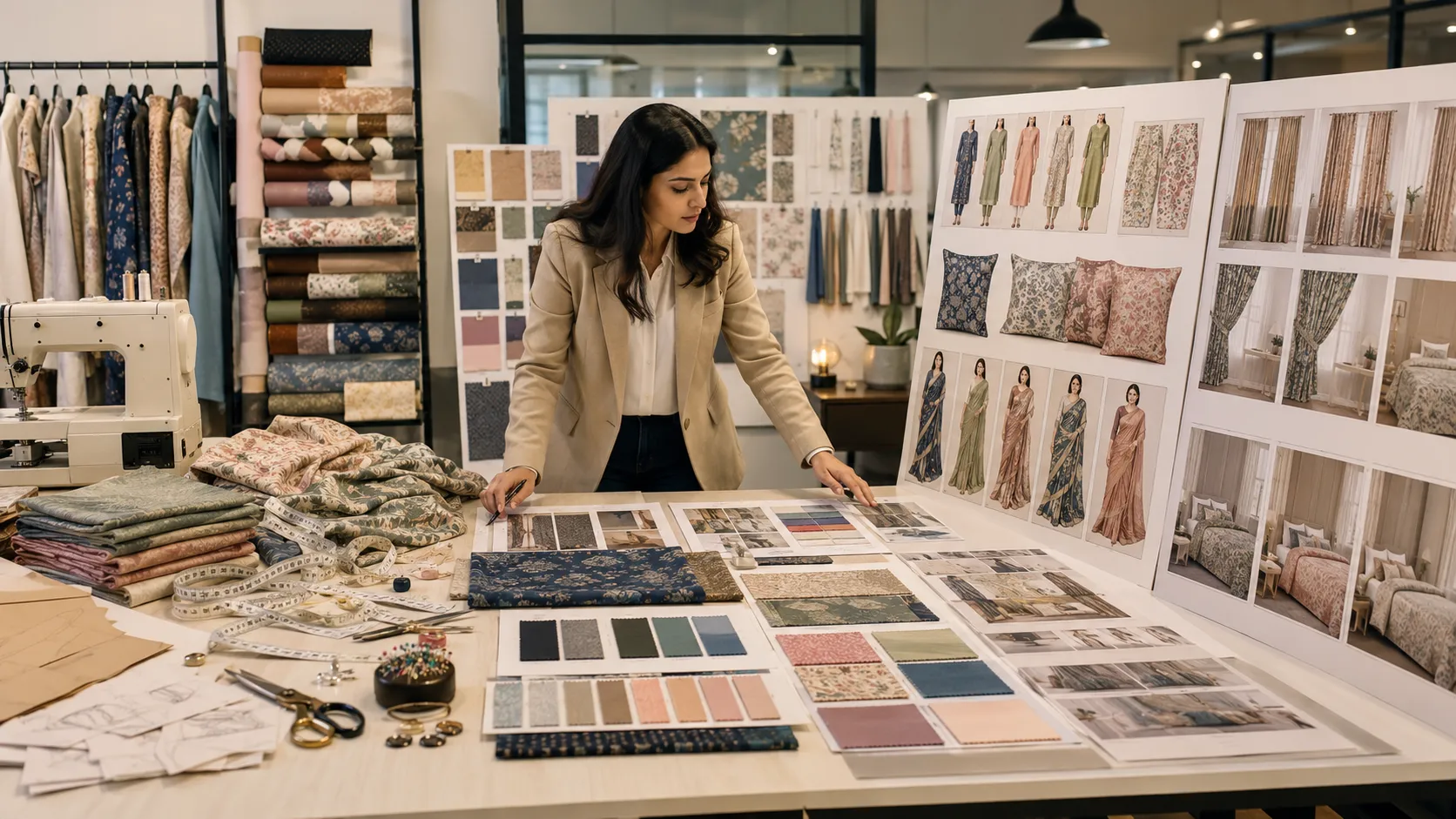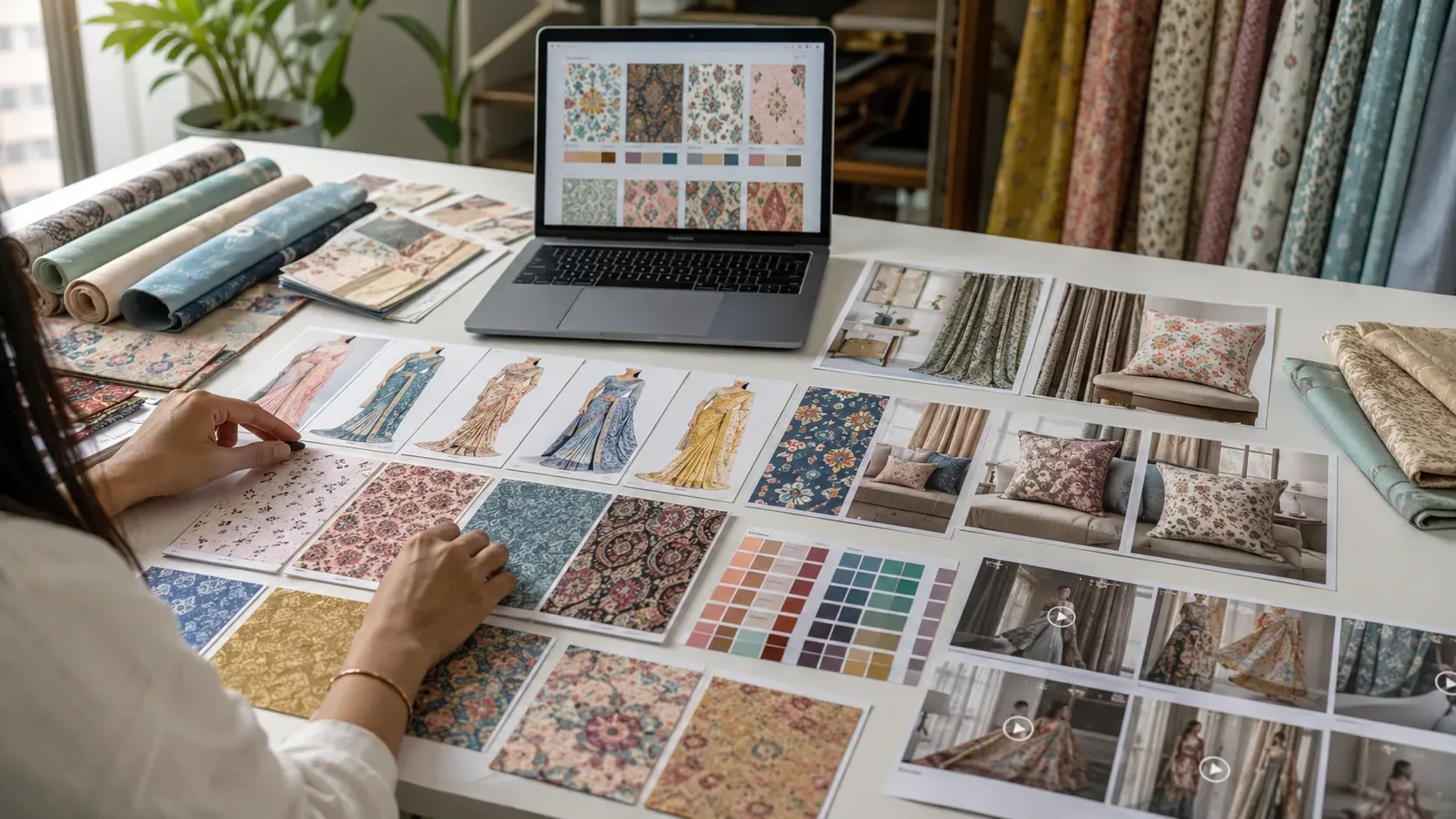
Textile design is no longer only about creating patterns on fabric.
Today, textile and fashion businesses need to show how those designs will look as real products. A fabric swatch may look beautiful, but buyers often want to see it as a garment, saree, catalog image, home textile product, lifestyle banner, model-worn photo, or video ad before making a decision.
This is why AI tools are becoming important for textile design and product visualization.
AI can help textile sellers, fashion brands, boutiques, saree sellers, Shopify stores, manufacturers, exporters, and e-commerce teams create product visuals faster. Instead of waiting for every physical sample, photoshoot, catalog design, or editing cycle, businesses can use AI to create quick previews and marketing-ready images.
The Textile AI brings many of these tools together in one platform.
It helps users turn fabric ideas into garment previews, product mockups, catalog images, saree drape visuals, virtual try-on results, photoshoot images, banners, videos, color variants, and upscaled visuals.
Website:
https://www.thetextileai.com/
Why Textile Businesses Need AI Tools
Textile businesses work with many visual decisions.
A designer may need to test how a print looks on a kurti or shirt. A fabric seller may need to show a buyer how one fabric can become different products. A saree seller may need model-worn catalog images. A home textile brand may need cushion, curtain, or table runner mockups. A fashion brand may need product photos for Shopify, Instagram, ads, and buyer decks.
Traditionally, all of this required sampling, stitching, photography, editing, and catalog formatting.
That workflow is useful, but it takes time.
AI tools help speed up the early visual stage. They allow businesses to create digital product previews before investing in full production or photoshoots.
This helps teams test ideas faster, reduce delays, improve product presentation, and launch content more quickly.
“AI textile tools help brands move from fabric idea to product visual faster.”
What is Textile Design AI?
Textile Design AI means using artificial intelligence to create, visualize, and present textile designs.
It can help turn fabric photos into garment mockups, generate catalog-ready product images, create model-worn fashion visuals, show sarees in draped form, create home textile product images, generate banners, create videos, and improve image quality.
This does not mean AI replaces textile designers.
The creative direction still comes from people. Fabric choice, color taste, product planning, customer understanding, and final approval still need human judgment.
AI simply helps make the visual process faster.
Instead of explaining a design only through flat fabric photos, businesses can show the final product possibility.
Remember: Textile Design AI is useful because buyers understand products faster when they can see them visually.
Fabric to Garment AI
Fabric to Garment AI is one of the most useful tools for textile sellers and designers.
This tool helps users upload a fabric or textile image and show it as a finished garment or product mockup. A flat fabric photo can be converted into a kurti, shirt, blazer, t-shirt, or custom garment visual.
This is useful because buyers often cannot imagine how fabric will look after stitching.
A print may look simple as a swatch but beautiful as a kurti. A border fabric may look more premium when shown on a garment. A shirt fabric may look more convincing when shown on a model.
Fabric to Garment AI helps businesses test these possibilities faster.
It is useful for textile sellers, fabric manufacturers, fashion designers, boutiques, garment makers, and e-commerce brands.
Website:
https://www.thetextileai.com/ai/tools/fabric-to-garment
Why Fabric to Garment AI is Useful
Fabric to Garment AI helps reduce early sampling pressure.
Instead of creating physical samples for every fabric design, businesses can first generate digital previews. This helps teams shortlist better ideas before production.
For example, a textile seller can show one fabric as a kurti, shirt, blazer, t-shirt, or custom garment. A designer can test which silhouette works best. A boutique can show customers how a fabric may look after stitching.
This saves time and makes communication easier.
Tip: Use Fabric to Garment AI before physical sampling to test more ideas with less cost.
Fabric to Product AI
Fabric to Product AI is useful for businesses that work beyond clothing.
Textile design is not limited to garments. Fabrics are also used for home decor, accessories, interiors, lifestyle products, and furnishing collections.
Fabric to Product AI helps users show fabric designs as finished products. A textile pattern can be visualized as a cushion cover, curtain, table runner, table cloth, sofa throw, or other product mockup.
This is very helpful for home textile brands, furnishing fabric sellers, decor brands, exporters, and interior product businesses.
A fabric swatch may not show full value on its own. But when the same design is shown as a finished product, buyers can understand its use more clearly.
“A fabric becomes easier to sell when buyers can see what it can become.”
AI Catalog Generator
AI Catalog Generator helps clothing brands create catalog-ready product images faster.
Catalog images are important for fashion and e-commerce. A product page usually needs more than one image. Customers want to see front view, side view, back view, close-up details, and model-worn angles.
Traditional catalog photography can be slow and expensive, especially when a brand has many products.
AI Catalog Generator helps create product visuals using model and garment inputs. It can help generate front, side, back, detail, close-up, and slight angle catalog images.
This is useful for Shopify stores, clothing brands, boutiques, D2C brands, garment manufacturers, wholesalers, and catalog teams.
Website:
https://www.thetextileai.com/ai/tools/catalog
Why AI Catalog Generator is Useful
AI Catalog Generator is useful because it helps brands create a complete product gallery faster.
A single image may not be enough to sell a garment online. Customers want to understand the fit, design, fabric detail, back view, and overall product look.
AI-generated catalog images can support product pages, buyer presentations, social media posts, online listings, and product launch planning.
For clothing brands, this means faster catalog creation and better visual consistency.
Remember: A clean catalog makes a fashion brand look more professional.
AI Saree Catalog Generator
Saree catalog creation is one of the most detailed visual workflows in fashion.
A saree is not just a fabric. It has a drape, pallu, pleats, blouse, border, fall, fabric shine, and styling mood. A flat saree photo is useful, but many customers want to see the saree as a complete worn look.
AI Saree Catalog Generator helps sellers create model-worn saree catalog images from raw saree assets.
A seller can upload a raw saree photo and optional references like blouse front, blouse back, zoomed pattern, and model reference. The AI can then create saree catalog images in different poses and aspect ratios.
This is useful for Shopify saree stores, Instagram sellers, boutiques, manufacturers, wholesalers, and ethnic wear brands.
Website:
https://www.thetextileai.com/ai/tools/saree-drape-e-commerce-studio
Why AI Saree Catalog Generator is Useful
Saree sellers often face high photoshoot costs.
Every saree needs proper draping, model styling, blouse matching, lighting, editing, and multiple poses. For sellers with many products, this becomes expensive and slow.
AI saree catalog generation helps create model-worn visuals faster.
It helps customers see the pallu, pleats, blouse, border, and overall drape more clearly.
Tip: Use AI saree catalog images as main product visuals and keep real fabric close-ups as supporting proof images.
Virtual Try-On AI
Virtual Try-On AI helps fashion brands show garments on models faster.
In a traditional workflow, brands need to arrange model photoshoots to show how a garment looks when worn. This can be slow when many products, colors, or styles are involved.
Virtual Try-On AI helps users upload a model image and garment image, then generate a model-worn output.
This is useful for clothing brands, e-commerce sellers, boutiques, fashion marketers, and product teams.
It helps create model-worn product visuals without arranging a full shoot every time.
Website:
https://www.thetextileai.com/ai/tools/virtual-try-on
Why Virtual Try-On AI is Useful
Virtual Try-On AI helps customers and brands visualize garments better.
A flat product photo may not show how the garment looks on a person. A model-worn visual gives more context.
This is useful for online fashion stores because customers want to imagine the final look before buying.
Virtual try-on can also help brands create more content for product pages, social media, and catalog previews.
“Virtual Try-On AI helps fashion products move from flat image to worn visual faster.”
AI Fashion Photoshoot
AI Fashion Photoshoot tools help brands create model-style fashion images without arranging every traditional studio shoot.
Fashion photoshoots usually need models, locations, lighting, styling, makeup, photographers, and editing teams. This works well for premium campaigns, but it can be expensive for regular product content.
AI Fashion Photoshoot helps generate fashion visuals faster for product launches, lookbooks, social media, ads, and campaign planning.
A clothing brand can create premium-looking model visuals and test different fashion moods before investing in a full shoot.
This is helpful for D2C fashion brands, Shopify stores, social media sellers, and marketing teams.
Tip: Use AI Fashion Photoshoot for fast campaign testing and visual planning.
AI Video Ads
Video content is important for modern fashion and textile marketing.
Brands need reels, ads, product teasers, launch videos, and social media content. Traditional video production can be expensive because it needs filming, editing, direction, models, lighting, and post-production.
AI Video Ads help brands create short promotional visuals faster.
Fashion brands can turn product images or campaign visuals into video-style content for online promotions. This is useful for ads, Instagram, YouTube Shorts, website sections, and launch campaigns.
For textile businesses, video helps make products feel more active and engaging.
Remember: AI video tools are useful when brands need frequent product-focused marketing content.
Banner Generator
Banner images are important for fashion and textile websites.
A homepage banner creates the first impression. Product launch banners, category banners, festive campaign visuals, and ad banners help guide customers toward collections.
Traditional banner design needs product images, background styling, layout work, editing, and revisions.
AI Banner Generator helps create banner-style visuals faster.
A textile or fashion brand can create visuals for website hero sections, collection campaigns, social media ads, and launch pages.
This is useful for businesses that need fresh campaign visuals regularly.
Tip: Use AI banners for fast campaign creation, then refine the best design direction for final publishing.
Color Variant AI
Color variants are important in textile and fashion.
A buyer may like a fabric design but want to see it in different colors. A clothing brand may need seasonal shades. A saree seller may want to show multiple colorways. A home textile brand may need different palette options for the same print.
Color Variant AI helps create color options faster.
Instead of manually editing or producing physical samples for every color, businesses can generate digital color previews first.
This supports buyer approvals and product planning.
Physical samples are still important for final color matching, but AI makes early color exploration faster.
“AI color variants help textile teams compare more options before production.”
Image Upscale AI
Image quality matters in textile and fashion.
A blurry or low-resolution product image can make a good product look weak. Fabric details, embroidery, print clarity, border work, stitching, and texture need sharp presentation.
Image Upscale AI helps improve image clarity.
It can help make product visuals more suitable for catalogs, websites, product pages, banners, and marketing materials.
This is useful when businesses have old product images, low-resolution visuals, or AI-generated outputs that need better sharpness.
For textile businesses, image clarity is important because buyers judge fabric quality visually.
Remember: Better image quality makes product presentation stronger.
Advanced Fabric AI
Advanced Fabric AI helps create or visualize fabric textures, weaves, and surface finishes.
Textile design is not only about print. It also includes fabric feel, weave style, shine, material finish, embroidery, structure, and texture.
AI can help designers explore fabric styles digitally before production.
A design may look different on silk, cotton, linen, satin, denim, chiffon, or embroidered fabric. Advanced fabric visualization can help teams understand these possibilities faster.
This is useful for textile designers, fabric developers, fashion teams, and product planners.
Tip: Use Advanced Fabric AI to explore texture direction before final material development.
How AI Tools Help Product Visualization
Product visualization is the process of showing how a design will look as a real product.
For textile businesses, this is very important.
A fabric can become a garment. A garment can become a catalog image. A saree can become a model-worn drape. A product can become a banner, video, ad, or product page visual.
AI tools help connect these steps.
Instead of waiting for every physical sample or photoshoot, businesses can create product previews earlier. This helps them test ideas, get buyer feedback, prepare online content, and launch products faster.
“Product visualization helps buyers see the final value of a textile design.”
How AI Tools Help E-Commerce Brands
E-commerce brands need visuals constantly.
A Shopify store needs product images, collection images, catalog galleries, banners, videos, ads, and social media content. If visuals are delayed, product launches are delayed.
AI tools help create these assets faster.
A fashion seller can use AI to create catalog images. A saree seller can generate draped product visuals. A fabric seller can show fabrics as finished garments. A home textile store can create product mockups. A brand can use AI to create banners, videos, and campaign visuals.
This helps products go live faster and improves online presentation.
Remember: Online products cannot sell properly until the visuals are ready.
How AI Tools Help Textile Manufacturers
Textile manufacturers often handle large collections.
They may have many fabrics, prints, colors, and product applications. Creating physical samples and photoshoots for every design can slow down the sales process.
AI tools help manufacturers create visual previews faster.
A manufacturer can show a fabric as garments, home products, catalog images, or buyer presentation visuals. This makes collection presentation more professional.
For wholesale, export, and B2B buyers, visuals can make decisions easier.
Tip: Manufacturers can use AI visuals to support buyer approvals before creating large sample sets.
How AI Tools Help Small Businesses
Small textile and fashion businesses often have limited budgets.
They may not have access to frequent studio shoots, professional models, large design teams, or expensive editing workflows. But they still need strong visuals to compete online.
AI tools make professional visual creation more accessible.
A small boutique can create garment previews. A saree seller can create catalog images. A Shopify seller can create product photos and banners. A fabric seller can show product mockups.
This helps small businesses look more professional without building a large production team.
“AI gives small textile businesses a faster way to create premium-looking product visuals.”
How AI Tools Help Large Brands
Large brands need AI for scale.
A large clothing or textile brand may have hundreds of products, many color variants, regular launches, seasonal campaigns, and multiple marketing channels.
Manual content creation at this scale becomes difficult.
AI tools help large teams generate more visual options faster. They can create catalog drafts, product previews, campaign ideas, color variants, and social media assets with less delay.
This helps design, catalog, e-commerce, and marketing teams work more efficiently.
Remember: For large brands, AI is not only a creative tool. It is also a workflow speed tool.
AI Tools vs Traditional Textile Workflows
Traditional textile workflows are still important.
Physical sampling is needed to check fabric feel, stitching, fit, drape, GSM, wash behavior, quality, and production feasibility. Real photography is important for premium brand campaigns and final product validation.
AI tools are useful before and around these steps.
They help teams create early previews, test ideas, reduce unnecessary samples, prepare buyer visuals, and create marketing content faster.
The best workflow is not AI only or traditional only.
The best workflow combines both.
Use AI for speed, testing, and visual creation. Use traditional methods for final quality, production approval, and premium brand storytelling.
“AI helps textile teams move faster, while traditional expertise protects final quality.”
Best Use Cases for AI Textile Design Tools
AI textile design tools can support many business workflows.
They can help with fabric-to-garment previews, product mockups, catalog images, saree drape visuals, virtual try-on outputs, AI fashion photoshoots, banner images, video ads, color variants, image upscaling, and buyer presentation visuals.
The most useful use cases include:
- Showing fabric as finished garments
- Creating catalog-ready product images
- Generating saree catalog images
- Creating home textile product mockups
- Creating virtual try-on visuals
- Generating AI fashion photoshoots
- Creating website banners
- Creating AI video ads
- Generating color variants
- Improving product image quality
- Preparing buyer presentations
- Reducing early sampling
- Launching e-commerce products faster
These use cases make AI useful for design, sales, catalog, and marketing teams.
Common Mistakes to Avoid
AI tools can help a lot, but they should be used carefully.
One common mistake is uploading unclear images. If the fabric, garment, saree, or model photo is blurry or poorly lit, the final output may not be accurate.
Another mistake is using vague instructions. AI works better when the prompt is clear about product type, background, lighting, pose, fabric accuracy, and output purpose.
A third mistake is using AI outputs without review. Textile visuals must be checked carefully for color, pattern, border, embroidery, texture, fit, blouse design, and product realism.
AI can make the workflow faster, but quality control still matters.
Remember: AI can generate visuals quickly, but the brand must still approve accuracy.
How to Get Better Results from AI Textile Tools
To get better results, start with good input images.
Use clear fabric photos, garment images, saree references, blouse details, model photos, and product references. Make sure important details are visible.
Write direct instructions.
If you want a catalog image, mention clean background and product-focused framing. If you want a garment mockup, mention the product type clearly. If you want a saree catalog image, mention pallu, pleats, blouse, border, and model pose. If you want a banner, mention the campaign mood and layout.
Review outputs before publishing.
AI is fast, but final product presentation should always be checked by the brand.
Tip: Good input plus clear instruction creates better AI output.
Why The Textile AI is Useful
The Textile AI is useful because it brings multiple textile and fashion AI tools into one platform.
Instead of using separate tools for fabric visualization, product mockups, catalog images, saree drape visuals, virtual try-on, photoshoots, banners, videos, and image enhancement, businesses can explore these workflows from one place.
This is helpful for textile sellers, clothing brands, saree businesses, home textile sellers, Shopify stores, fashion designers, manufacturers, wholesalers, exporters, and marketing teams.
The platform supports both product visualization and content creation.
That makes it useful not only for design teams, but also for sales and e-commerce teams.
Website:
https://www.thetextileai.com/
The Future of AI in Textile Design
AI will become a normal part of textile and fashion workflows.
Businesses will use AI to test ideas faster, create product previews, reduce early sampling, generate catalog images, prepare buyer presentations, create e-commerce content, and launch campaigns faster.
Traditional textile knowledge will still matter.
Fabric quality, production, stitching, sampling, fit, and finishing will always need real-world expertise.
But AI will help brands reduce waiting time between design and presentation.
In the future, a textile design may quickly become a garment preview, catalog image, saree drape visual, product mockup, banner, video, and buyer presentation asset.
This will make textile businesses more visual, faster, and more competitive.
Final Thoughts
AI tools are becoming important for textile design and product visualization.
They help businesses show fabric as finished garments, create catalog images, generate saree visuals, produce virtual try-on outputs, create photoshoot images, build banners, make videos, test color variants, and improve image quality.
For textile sellers, AI makes fabric easier to present. For fashion brands, it speeds up product image creation. For saree businesses, it improves catalog presentation. For home textile brands, it helps show product mockups. For e-commerce stores, it helps create content faster.
AI does not replace textile expertise.
It helps textile expertise become visible faster.
Explore The Textile AI here: