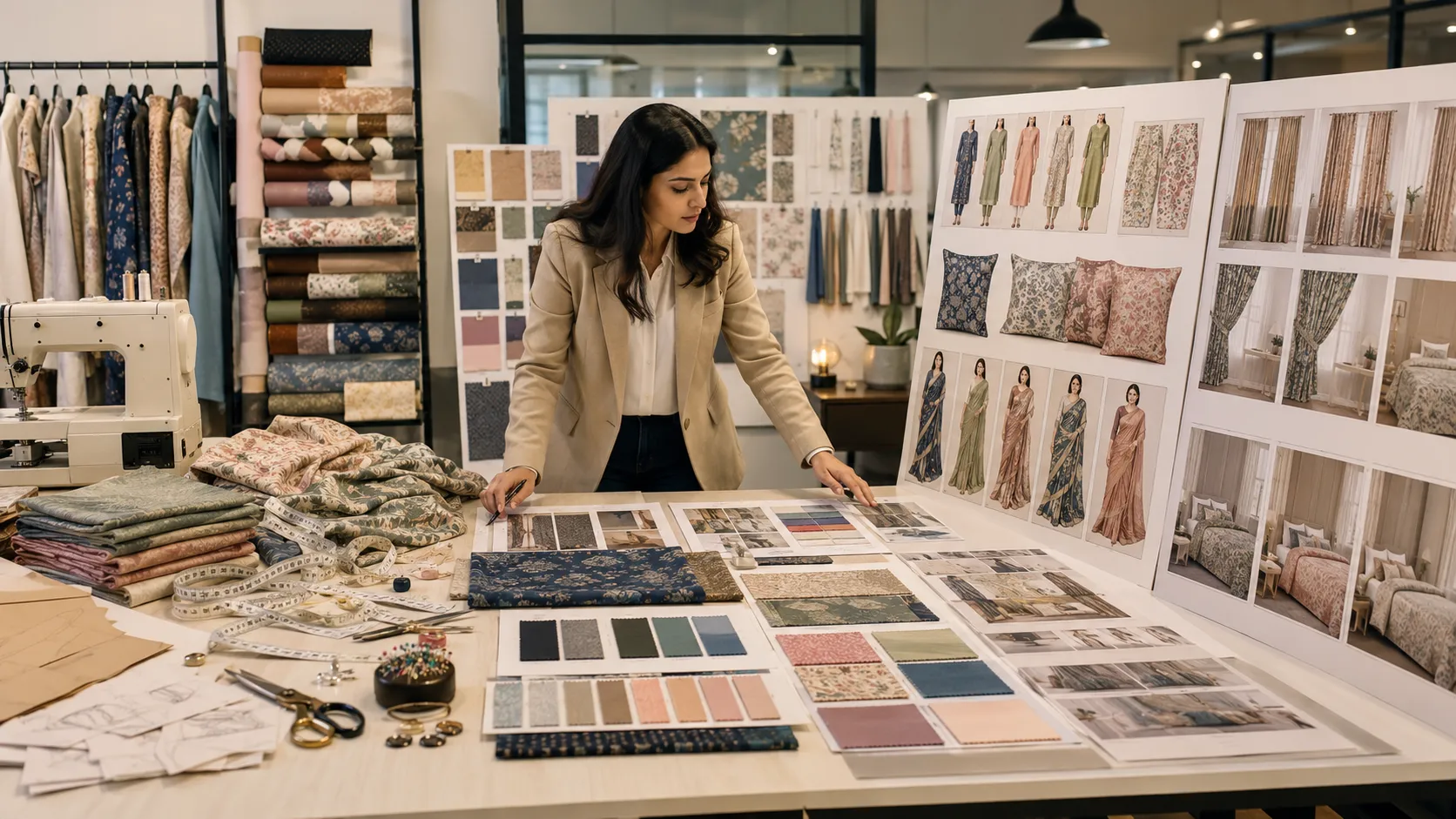
Selling fabric is not only about showing color and pattern.
It is about helping the buyer imagine the final product.
A textile seller may have a beautiful fabric swatch, but the buyer still needs to understand how that fabric will look after it becomes a:
- Kurti
- Shirt
- Blazer
- T-shirt
- Curtain
- Cushion cover
- Table product
This is where many textile sellers face a problem.
A flat fabric image can show the design, but it cannot always show the final use.
Customers and buyers may like the fabric, but they may still hesitate because they cannot clearly imagine the finished garment.
AI is now helping textile sellers solve this problem.
With AI fabric visualization tools, sellers can upload a fabric image and show that same fabric as a realistic garment, AI model preview, or product mockup.
This makes fabric selling more visual, more professional, and easier for buyers to understand.
The Textile AI Fabric to Garment tool helps textile sellers turn fabric images into finished product visuals for fashion and home textile use cases.
Tool link:
https://www.thetextileai.com/ai/tools/fabric-to-garment
Why Textile Sellers Need More Than Fabric Photos
A normal fabric photo is useful, but it does not tell the full story.
When a buyer sees a swatch, they may ask:
- Will this fabric look good as a kurti?
- Can this print work for a shirt?
- Will the pattern look too large on a garment?
- Can this fabric be used for home decor?
- How will this fabric look on a model?
- Can I show this to my customer before stitching?
These questions are common because fabric buying depends on imagination.
Some buyers are experienced and can imagine the final product quickly.
But many customers, boutique owners, online sellers, and small retailers need visual support.
AI helps by turning imagination into a preview.
Instead of saying, “This fabric will look good as a kurti,” the seller can show the fabric as a kurti.
Instead of saying, “This print can work for curtains,” the seller can show a curtain mockup.
That small change can make the selling process much stronger.
“A fabric image shows what the textile is. A finished garment visual shows what the textile can become.”
The Big Challenge in Fabric Selling
Textile sellers often have many designs.
They may have hundreds of:
- Prints
- Colors
- Borders
- Textures
- Fabric categories
Creating stitched samples for every fabric is not practical.
If a seller wants to show every fabric as a garment, they need to spend on:
- Cutting
- Stitching
- Photography
- Model shoots
- Editing
- Catalog preparation
This takes too much time.
It also increases cost.
For online sellers, the challenge is even bigger.
Customers cannot touch or feel the fabric, so product visuals become very important.
A weak fabric photo may not create enough interest, even if the fabric is actually good.
That is why many sellers are now looking for faster visual methods.
AI fabric to garment tools help sellers create product previews without producing every sample physically.
Remember: The goal is not to replace real fabric quality. The goal is to show the fabric’s potential faster.
How AI Changes the Fabric Selling Workflow
AI makes the fabric selling workflow more visual.
Earlier, a seller would upload a fabric photo and wait for the buyer to imagine the final use.
Now, the seller can show the fabric as a finished garment or product mockup.
This creates a more complete presentation.
A modern AI-powered workflow can look like this:
- The seller uploads a clear fabric image
- The seller selects the model type
- The seller chooses AI Model or Product Mockup output
- The seller selects a product category
- The seller applies fabric safety rules
- The seller adds custom styling instructions if needed
- The AI generates the finished garment or product visual
- The seller uses the image for buyer presentation, catalog, website, or social media
This workflow is faster than making a physical sample for every design.
It also gives sellers more flexibility.
One fabric can be shown in multiple product directions before deciding the best use.
Turning Fabric into Wearable Garment Visuals
One of the strongest uses of AI for textile sellers is wearable visualization.
Many buyers want to see how fabric looks as clothing.
This is especially important for:
- Fashion fabrics
- Boutique fabrics
- Ethnic wear fabrics
- Menswear prints
- Kidswear materials
- Casualwear textiles
Using AI, fabric can be shown as:
- Kurti
- Blazer
- Shirt
- T-shirt
- Custom wearable design
Kurti Preview
A kurti preview is useful for fabric sellers who work with ethnic wear customers, boutiques, and Indian fashion brands.
Many customers buy fabric specifically for kurtis, so showing the fabric in a long or short kurti form makes the decision easier.
Shirt Preview
A shirt preview is useful for menswear and casualwear fabrics.
It helps buyers understand how the fabric will look on:
- Collars
- Sleeves
- Front panels
- Overall shirt structure
Blazer Preview
A blazer preview is useful for premium and western wear fabrics.
Some fabrics look ordinary as a swatch but look very strong when shown as a structured blazer.
A blazer gives the fabric a more polished and premium context.
T-shirt Preview
A t-shirt preview is useful for:
- Casual prints
- Youth designs
- Kidswear prints
- Simple fashion collections
It helps sellers quickly check whether the fabric works for everyday clothing.
Custom Wearable Preview
The custom option gives sellers more freedom.
If the fabric is meant for a jacket, co-ord set, tunic, poncho, or another garment, custom instructions can help guide the AI.
Tip: When selling fabric online, show the same fabric in the most likely garment use. It helps customers understand the fabric faster.
Using AI Models to Improve Fabric Presentation
Model-based previews are powerful because customers can see the fabric in use.
A flat fabric image is static.
But a model-worn image shows:
- Shape
- Fall
- Styling
- Product mood
- Real-life visual appeal
The Textile AI Fabric to Garment tool allows users to select model type such as:
- Male
- Female
- Male and female
- Kids girl
- Kids boy
- Teen or youth
This is useful because different fabrics are meant for different audiences.
For example:
- A formal print may need a male model.
- A kurti fabric may need a female model.
- A playful print may need a kidswear preview.
- A youth fashion fabric may need a teen or youth model.
When the model type matches the target buyer, the image becomes more useful.
A seller can create a more relevant presentation instead of using one generic look for every fabric.
“The right model preview helps buyers see the fabric in the right market context.”
Product Mockups Without a Model
Not every fabric needs to be shown on a model.
Sometimes sellers need clean product mockups without a person.
This is especially useful for:
- Home textile products
- Decor collections
- Product catalogs
- Simple e-commerce previews
Product Mockup output helps convert fabric into finished product visuals without using an AI model.
This can be useful for showing fabric as:
- Table runner
- Table cloth
- Window curtains
- Sofa throw
- Cushion cover
- Kitchen apron
- Table napkins
This is important because many textile sellers do not only sell fashion fabric.
They may also sell:
- Furnishing fabrics
- Decor fabrics
- Dining textile materials
- Kitchen textile fabrics
- Home living collections
AI product mockups help these sellers show fabric in a real product context.
A buyer can immediately see whether the fabric suits a cushion cover, curtain, or table runner.
Remember: Fabric value often changes depending on product context. AI helps sellers show that context clearly.
Why Home Textile Sellers Can Benefit from AI
Home textile selling depends strongly on placement.
A fabric can look very different as a curtain compared to a cushion cover.
For example:
- A large print may look beautiful on a table cloth but too crowded on napkins.
- A small repeat pattern may look simple as a swatch but elegant on a table runner.
- A bold design may look strong on curtains but too heavy on small decor products.
- A soft floral print may work better for cushions or curtains.
AI helps sellers test these product ideas before production.
For home textile businesses, this can support faster catalog planning and better buyer presentation.
A seller can upload one fabric and generate different home textile previews.
This helps the seller understand where the fabric looks best.
It also helps buyers compare product possibilities.
For exporters and home decor brands, this can be very useful because buyers often want to see finished product examples before placing orders.
How AI Helps Textile Sellers Build Better Catalogs
Catalogs are important in textile selling.
A good catalog does not only show fabric thumbnails.
It helps buyers understand:
- The collection
- Product possibilities
- Design range
- Final use
- Product value
AI-generated garment visuals can make a fabric catalog more powerful.
Instead of showing only flat swatches, a seller can include:
- Fabric-to-garment images
- AI model previews
- Product mockups
- Home decor visuals
This makes the catalog feel more complete.
For example, a fabric catalog page can show the original fabric swatch on one side and a finished kurti or shirt preview on the other side.
A home textile catalog can show the same fabric as:
- Curtains
- Cushion covers
- Table runners
This type of presentation can help buyers make decisions faster.
Tip: Use the original fabric image and AI product preview together. The fabric image shows detail, and the product preview shows final use.
How AI Helps Online Fabric Sellers
Online fabric selling is difficult because customers cannot touch the material.
They cannot physically feel:
- Weight
- Softness
- Fall
- Texture
- Finish
So visuals become very important.
A fabric seller who only uploads flat fabric photos may struggle to show the real value of the product.
AI helps make online listings more attractive.
A seller can use AI-generated visuals for:
- Product pages
- Shopify listings
- Instagram posts
- WhatsApp catalogs
- Marketplace images
- Buyer messages
For example, if a customer is looking for kurti fabric, the seller can show the fabric as a kurti preview.
If another customer is looking for home decor fabric, the seller can show the same design as a cushion cover or curtain.
This makes the product more understandable for different customers.
Remember: In online selling, clear visuals reduce doubt. Less doubt can lead to faster buying decisions.
AI for B2B Textile Sellers and Wholesalers
B2B textile selling often involves large collections.
Manufacturers, wholesalers, and exporters may need to show hundreds of fabrics to buyers.
Buyers may not have time to imagine every design as a finished product.
AI helps by creating visual product previews.
A wholesaler can show how different fabrics look as garments.
A manufacturer can create buyer-ready presentations.
An exporter can prepare more attractive digital catalogs for international clients.
This can make communication easier.
Instead of sending only raw fabric images, the seller can send a more complete presentation with finished product possibilities.
This can help buyers shortlist designs faster.
“AI gives textile sellers a stronger way to present fabric value before the first sample is made.”
AI for Boutique and Custom Order Selling
Boutiques can also use AI to support customer consultation.
Many boutique customers choose fabric first and then decide what to stitch.
They may ask whether the fabric will look good as a:
- Long kurti
- Short kurti
- Shirt
- Custom outfit
AI can help the boutique show a visual direction before stitching.
This is useful because it reduces misunderstanding.
The customer can see an approximate style direction before finalizing the garment.
The boutique can use the preview as a discussion point.
This improves the customer experience.
It also makes the boutique look more modern and professional.
Design Accuracy Matters in Fabric Selling
When using AI for fabric previews, accuracy matters a lot.
Textile sellers cannot afford to show images that change the original fabric too much.
The generated visual should respect the fabric:
- Color
- Pattern
- Scale
- Embroidery
- Border
- Texture
That is why design safety rules are useful.
The Fabric to Garment tool includes safety rules such as:
- Preserving original fabric color
- Maintaining scale and design
- Preserving embroidery and border details
- Avoiding new motifs
- Keeping pattern placement realistic
- Using realistic draping
These rules help the AI stay closer to the uploaded fabric.
For sellers, this is important because the preview should support selling, not mislead the buyer.
A good AI preview should make the fabric look realistic while still keeping the original design identity.
Remember: AI visuals should help customers understand the fabric, not create a different fabric.
Using Custom Styling Instructions
Custom styling instructions are useful when sellers want a specific output look.
For example, a seller can ask the AI to show the fabric as a premium kurti with natural lighting and a clean catalog background.
Or they can ask for:
- Formal shirt preview
- Simple product mockup
- Home decor setting
- Premium studio look
- Product-card-friendly image
Custom instructions help guide:
- Mood
- Product angle
- Background
- Lighting
- Model pose
- Styling
This helps sellers create visuals that match their brand.
For example:
- A boutique may want a clean elegant background.
- A Shopify seller may want product-card-friendly images.
- A home decor seller may want a lifestyle interior style.
- A wholesaler may want simple catalog previews.
Tip: Custom prompts work best when they are short, clear, and specific. Tell the AI what to create and what details must not change.
How AI Helps Reduce Sampling Cost
Many textile sellers create samples only because they need to show buyers the final look.
This can become expensive.
If a seller has 50 fabric designs and wants to show each design as a garment, physical sampling can take a lot of money and time.
AI helps reduce early-stage sampling.
Sellers can first create digital previews and show them to buyers.
Once the buyer is interested, the seller can create physical samples for selected designs.
This saves time and reduces waste.
AI does not replace final physical sampling.
Buyers may still need to check:
- Fabric feel
- Stitching
- Fit
- Production quality
But AI helps reduce unnecessary samples before that stage.
“AI helps sellers sample smarter, not blindly.”
How AI Helps Buyers Make Faster Decisions
Buyers often take time to approve fabric because they cannot see the final product clearly.
A fabric swatch alone may not be enough.
But when the fabric is shown as a finished garment or product mockup, the decision becomes easier.
Buyers can compare options more clearly.
They can see:
- Which fabric suits clothing
- Which fabric works better for home decor
- Which design should move forward
- Which product direction looks strongest
This can reduce back-and-forth communication.
It can also make presentations more professional.
For textile sellers, faster buyer decisions mean faster movement from inquiry to order.
Using AI Images for Social Media and Marketing
Textile sellers can also use AI-generated garment images for marketing.
A fabric shown as a finished product is more engaging than a flat swatch.
For social media, this can improve attention.
A seller can create Instagram posts showing a fabric as:
- Kurti
- Shirt
- Curtain
- Cushion cover
- Table runner
- Home textile product
They can create WhatsApp catalog previews for customers.
They can create product launch visuals for new fabric collections.
This helps sellers post more useful content without arranging photoshoots every time.
For small sellers, this can be a big advantage.
They can create professional-looking visuals even with limited resources.
AI Model Preview vs Product Mockup for Sellers
Both output styles are valuable for textile sellers.
AI Model Preview
AI Model Preview is best when the seller wants to show how fabric looks when worn.
This is useful for:
- Fashion fabrics
- Boutique fabrics
- Kidswear materials
- Menswear prints
- Ethnic wear textiles
- Model-based catalog images
Product Mockup
Product Mockup is best when the seller wants to show a clean product-only output.
This is useful for:
- Home decor
- Furnishing fabrics
- Table linen
- Kitchen textiles
- Product catalogs
- E-commerce mockups
A seller can use both depending on the buyer.
For a boutique buyer, model preview may work better.
For a home decor buyer, product mockup may be more useful.
A smart seller does not use one format for everything.
They choose the output based on the target customer.
Best Use Cases for Textile Sellers
Textile sellers can use AI fabric visualization in many practical ways.
Best use cases include:
- Create garment previews from fabric swatches
- Show fabric as finished clothing
- Prepare buyer presentations
- Generate product mockups
- Test home decor applications
- Create Shopify product images
- Build WhatsApp catalogs
- Improve Instagram posts
- Reduce early sampling cost
- Make fabric collections look more premium
- Support design approval
- Create catalog visuals faster
This makes AI useful across selling, marketing, design approval, and catalog creation.
The same fabric can be shown in many product directions, which gives sellers more ways to convince buyers.
What Makes a Good AI Fabric Preview?
A good AI fabric preview should look realistic, clean, and close to the original fabric.
The fabric color should stay accurate.
The pattern scale should look natural.
The product shape should be believable.
The fabric should follow folds, shadows, and draping.
The image should not add random motifs or change the design identity.
The best results usually come from clear fabric images.
If the uploaded fabric image is blurry, folded, dark, or unclear, the AI may not understand the pattern properly.
That is why sellers should use clean fabric photos whenever possible.
Tip: Before uploading, check whether the fabric image clearly shows the print, color, texture, and design direction.
Why The Textile AI Fabric to Garment Tool is Useful for Sellers
The Textile AI Fabric to Garment tool is useful because it is built around real textile selling needs.
It supports:
- Fabric upload
- Multiple model types
- AI Model output
- Product Mockup output
- Wearable products
- Home living products
- Design safety rules
- Custom styling instructions
- Simple credit system
This makes it practical for different sellers.
A fabric wholesaler can create buyer previews.
A boutique can show custom garment ideas.
A Shopify seller can create product visuals.
A home textile seller can create decor mockups.
A fashion designer can test fabric use cases.
The tool helps sellers move from flat fabric image to finished product visual faster.
Tool link:
https://www.thetextileai.com/ai/tools/fabric-to-garment
The Future of Fabric Selling with AI
The future of fabric selling will be more visual.
Customers and buyers will expect more than swatch photos.
They will want to see how the fabric looks in real product form.
AI will help sellers create this experience quickly.
A single fabric may be shown as:
- Clothing
- Home decor
- Model preview
- Product mockup
- Catalog image
- Social media visual
This gives sellers more ways to present and promote the same textile.
In the coming years, textile sellers who use AI visualization may have an advantage.
They will be able to:
- Show more products faster
- Create better catalogs
- Reduce unnecessary sampling
- Improve buyer communication
- Make fabric collections easier to understand
Final Thoughts
AI is changing how textile sellers present fabric.
Instead of showing only flat swatches, sellers can now show fabric as:
- Finished garments
- Model-worn previews
- Product mockups
- Home textile visuals
This helps buyers understand the fabric better.
It reduces guesswork, improves presentation, saves time, supports faster approvals, and helps sellers create stronger product content.
For textile sellers, fabric is not just a material.
It is a future garment, a future product, and a future selling opportunity.
AI helps show that future clearly.
Try The Textile AI Fabric to Garment tool here:
https://www.thetextileai.com/ai/tools/fabric-to-garment