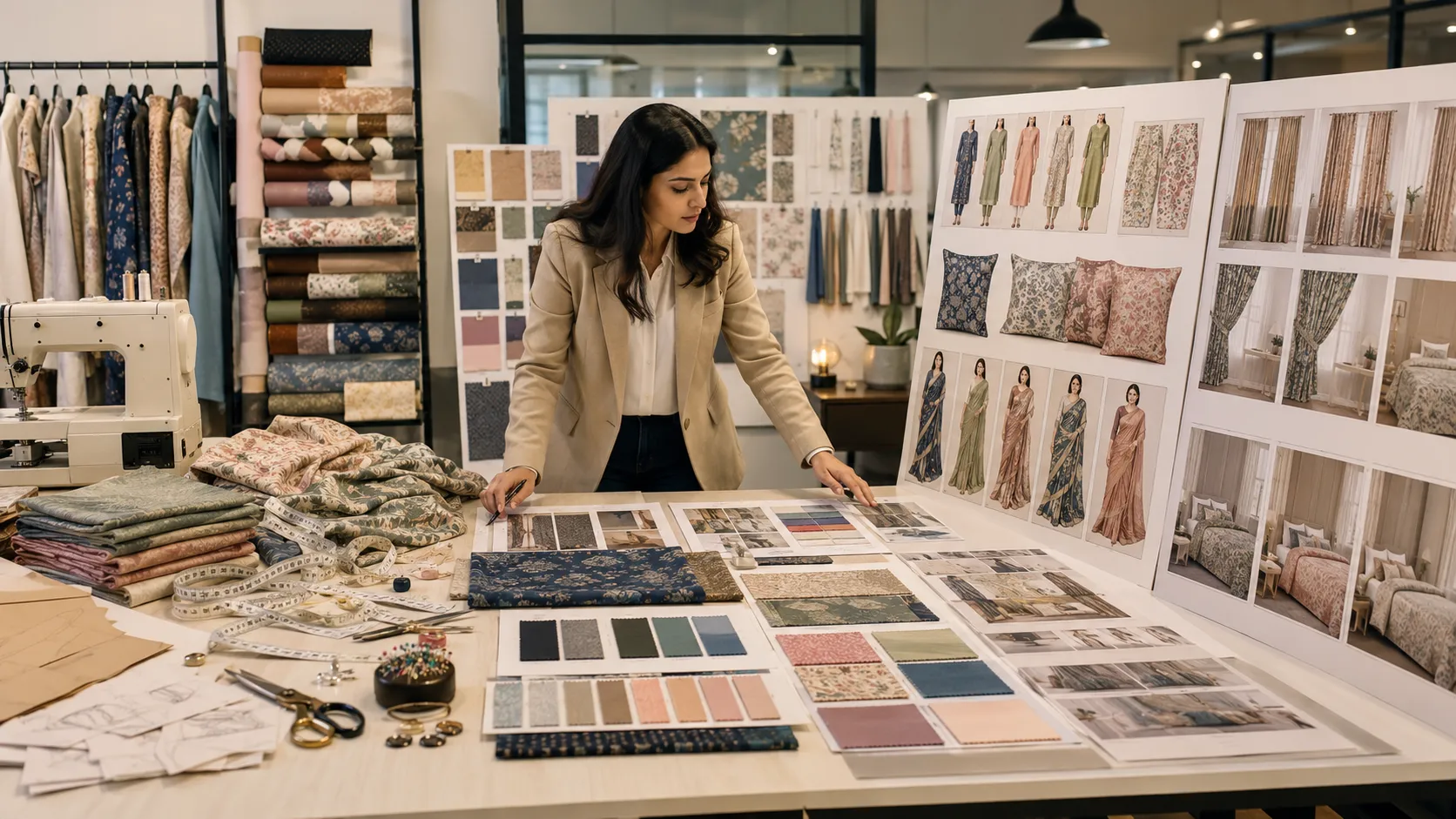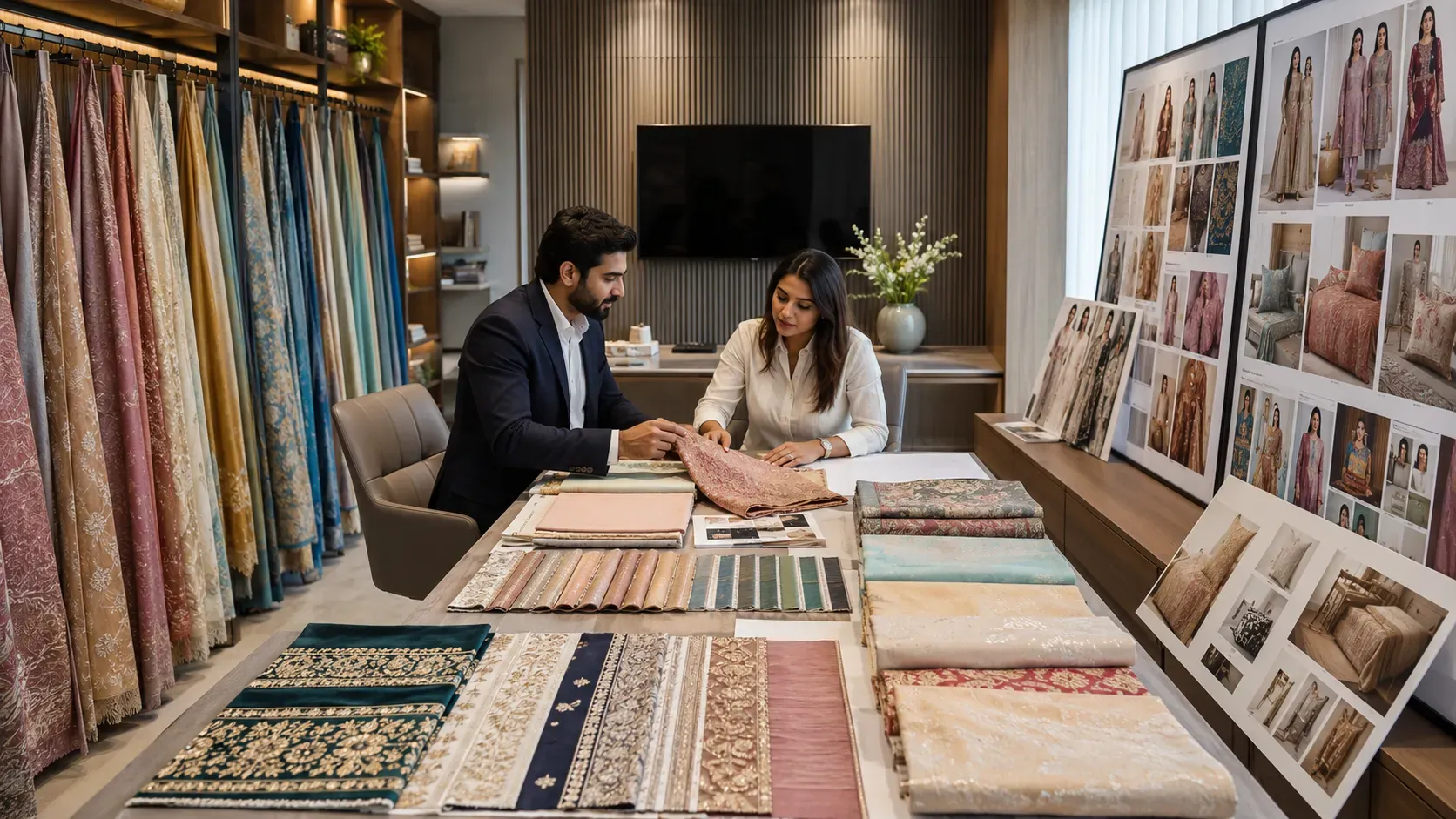
Textile selling is not only about fabric anymore.
A textile seller may have beautiful prints, premium embroidery, rich woven textures, elegant borders, soft cottons, glossy silks, furnishing fabrics, saree materials, and fashion-ready textiles. But buyers do not always make decisions by looking at raw fabric alone.
They want to understand what the fabric can become.
A buyer may ask whether a fabric will look good as a kurti, shirt, blazer, dress, saree, curtain, cushion cover, table runner, or catalog product. A flat fabric photo can show the material, but it may not show the final product possibility clearly.
This is where AI fabric visualization tools become useful.
AI fabric visualization helps textile sellers convert fabric photos into product visuals, garment previews, catalog images, home textile mockups, color options, and marketing-ready content. Instead of depending only on physical samples or manual mockups, sellers can use AI to show fabric in a more practical and attractive way.
For textile sellers, wholesalers, fabric manufacturers, exporters, boutiques, home textile brands, and Shopify sellers, AI fabric visualization can make selling faster and more visual.
The Textile AI helps textile businesses create fabric-to-garment visuals, fabric-to-product mockups, catalog images, fashion photoshoots, virtual try-on outputs, saree catalog images, banners, videos, color variants, and upscaled visuals.
Website:
https://www.thetextileai.com/
What Are AI Fabric Visualization Tools?
AI fabric visualization tools are artificial intelligence tools that help convert fabric images into finished product visuals.
In simple words, they help sellers show how a fabric may look in real use.
A fabric swatch can be shown as a garment. A textile print can be shown as curtains or cushion covers. A saree fabric can become a model-worn catalog image. A clothing product can be shown on a model. A fabric collection can become a product catalog or lifestyle campaign visual.
This helps buyers understand the fabric faster.
Traditionally, textile sellers had to explain everything with words, sample pieces, sketches, or physical stitched samples. But AI makes it possible to create visual previews before producing every sample.
This does not replace real fabric quality, touch, or production checking.
It helps sellers present the fabric better during the early decision stage.
“AI fabric visualization helps buyers see the product possibility behind the fabric.”
Why Raw Fabric Photos Are Not Always Enough
Raw fabric photos are important, but they are not always enough for selling.
A buyer can see the color, print, and texture from a fabric photo. But they may still not understand how the design will look after stitching or product making.
A print that looks busy as a flat swatch may look beautiful as a kurti. A simple woven fabric may look premium as a blazer. A furnishing print may look more valuable when shown as cushions or curtains.
This is the main gap in textile selling.
The seller sees the fabric potential because they understand textiles. But the buyer may need a visual example to understand the same value.
AI fabric visualization tools help close that gap.
They allow sellers to show the fabric as a finished product, not just as a material.
Remember: A fabric photo shows what the fabric is. A visualization shows what the fabric can become.
The Challenge Textile Sellers Face Today
Textile sellers work in a fast-moving market.
Buyers want quick previews. Fashion brands want faster product ideas. Boutiques want customer-ready visuals. Export buyers want clear presentations. Online stores need product images. Social media needs fresh content.
At the same time, creating physical samples for every fabric is not easy.
Sampling takes time, fabric, stitching, labor, photography, editing, and approval. If the buyer rejects the sample, that effort may not convert into business.
This becomes a bigger challenge when sellers have many designs, colorways, and product categories.
A seller may have hundreds of fabric options, but only a few can be sampled physically. This means many good designs may never be shown properly.
AI fabric visualization helps sellers create more previews without producing every sample first.
Tip: Use AI visualization before physical sampling to identify which fabrics have the strongest product potential.
How AI Fabric Visualization Helps Sellers Present Better
Presentation matters in textile business.
Two sellers may have similar fabric quality, but the seller who presents better visuals can make the product easier to understand. Buyers often respond faster when they can see clear product possibilities.
AI fabric visualization helps create those possibilities.
A fabric can be shown as a garment preview, home textile mockup, catalog image, model-worn visual, or lifestyle product scene. This gives the buyer a clearer idea of how the fabric can be used.
For example, instead of saying, “This fabric is good for kurtis,” the seller can show a kurti preview. Instead of saying, “This print will look good for home decor,” the seller can show it as cushions and curtains. Instead of sending only a swatch image, the seller can send product mockups with it.
This makes communication stronger.
“Better textile presentation helps buyers make faster decisions.”
Fabric to Garment Visualization
Fabric to Garment AI is one of the most useful tools for textile sellers.
It helps convert fabric photos into finished garment visuals. A seller can upload a fabric image and show it as a kurti, shirt, blazer, t-shirt, or custom garment.
This is useful because many buyers want to see how the fabric behaves on clothing.
Pattern scale, print placement, border visibility, fabric fall, and overall garment look become easier to understand when the fabric is shown on a finished garment.
For fashion buyers, this can make decision-making faster. For boutique owners, it can help explain custom outfit ideas. For fabric sellers, it can make the fabric look more market-ready.
The Textile AI Fabric to Garment tool helps sellers turn fabric images into realistic garment previews for fashion and product presentation.
Website:
https://www.thetextileai.com/ai/tools/fabric-to-garment
Fabric to Product Visualization
Textile sellers do not only sell for clothing.
Many fabrics are used for home textile and lifestyle products. Curtains, cushion covers, table cloths, table runners, sofa throws, kitchen aprons, and napkins all need visual presentation.
A fabric may look normal as a flat swatch but premium as a finished home textile product.
AI fabric-to-product visualization helps sellers show these product possibilities faster.
This is especially useful for furnishing fabric sellers, home textile manufacturers, decor brands, exporters, and online home product businesses.
Instead of making every sample physically, sellers can create digital product mockups first and show buyers how the fabric may look in real use.
Remember: Home textile buyers often need product context before they understand the fabric’s full value.
AI Catalog Images for Textile Sellers
Catalogs are still very important in textile business.
A good catalog helps buyers compare fabrics, understand product applications, and select designs more easily. But traditional catalog creation takes time because it needs product images, layouts, photography, editing, and formatting.
AI catalog tools can help textile sellers create catalog-ready visuals faster.
A fabric or garment product can be shown in a clean catalog format. A clothing item can be shown on a model with front, side, back, and detail views. A saree can be shown as a model-worn catalog image. A home textile design can be shown as a product mockup.
This helps sellers create stronger buyer presentations.
For online sellers, AI catalog visuals can also support product pages, Shopify stores, marketplace listings, Instagram posts, and WhatsApp catalogs.
Tip: Use AI catalog images when you need clean product presentation for buyers or online selling.
AI Saree Visualization for Saree Sellers
Saree sellers have a special need for visualization.
A saree is not only a piece of fabric. It is a complete draped look. Customers want to see the pallu, pleats, border, blouse, fabric fall, and overall styling.
A folded saree photo may show the product, but it may not show the full beauty of the saree.
AI saree visualization helps sellers create model-worn saree catalog images from raw saree photos and optional references like blouse front, blouse back, zoomed pattern, and model reference.
This is useful for Shopify saree sellers, boutiques, manufacturers, wholesalers, Instagram sellers, and ethnic wear brands.
A model-worn saree image can make the product easier to understand and more attractive for online buyers.
“Saree selling becomes stronger when customers can see the draped look, not only the folded fabric.”
Virtual Try-On for Textile and Fashion Sellers
Virtual Try-On AI helps sellers show garments on model photos.
This is useful when textile sellers also work with finished garments or apparel samples. Instead of showing only a flat garment image, they can create a model-worn visual using a model photo and garment image.
This helps customers and buyers understand how the product looks when worn.
For online fashion selling, model-worn visuals can improve product presentation. They help show fit, style, length, sleeve shape, neckline, and overall look.
Virtual Try-On AI is useful for clothing sellers, boutiques, e-commerce stores, fashion brands, and textile businesses that need faster model-worn product visuals.
Website:
https://www.thetextileai.com/ai/tools/virtual-try-on
AI Fashion Photoshoot for Better Marketing
Textile sellers also need marketing content.
A seller may need visuals for product launches, social media campaigns, buyer announcements, ads, website banners, and seasonal collections. Traditional photoshoots can be expensive and slow for regular content.
AI fashion photoshoot tools help create premium-looking fashion visuals faster.
This is useful when sellers want to show products in a more styled and campaign-ready way. A fabric or garment can be presented with better mood, model styling, lighting, and brand feel.
AI photoshoot visuals can support social media, ads, online stores, and lookbooks.
Tip: Use AI fashion photoshoot visuals when you want to make a product collection look more premium for marketing.
Color Variant Visualization
Color variants are important in textile selling.
Buyers often ask for the same design in different colors. A print may need a festive version, pastel version, dark version, neutral version, or buyer-specific palette.
Traditionally, color variant creation takes manual editing or physical sample production.
AI color variant tools help sellers show different color options faster.
This helps during buyer discussions because buyers can compare more options before asking for physical samples.
For textile sellers, this can improve approval chances and reduce unnecessary sampling.
Remember: AI color variants help buyers make faster color decisions before production starts.
Image Upscale for Better Product Presentation
Image quality is important in textile selling.
A blurry fabric photo can make a good product look weak. Buyers want to see fabric texture, border, embroidery, weave, print clarity, and color properly.
AI image upscale tools can help improve visual quality.
This is useful when sellers have old product photos, low-resolution images, or visuals that need sharper details for catalog and online use.
Better image clarity can improve product presentation on websites, catalogs, WhatsApp, social media, and buyer decks.
“Clearer textile images make product details easier to trust.”
How AI Fabric Visualization Reduces Sampling Cost
Sampling is one of the biggest cost areas in textiles.
Every sample needs material, cutting, stitching, finishing, photography, and review. When a seller has many fabrics, creating physical samples for all of them is not practical.
AI visualization helps reduce early sampling cost.
Sellers can first create digital previews and show buyers different possibilities. After buyer interest is confirmed, they can create physical samples only for selected designs.
This creates a smarter workflow.
AI does not remove the need for real samples. Final production still needs physical checking. But AI helps avoid unnecessary first-round samples.
Tip: Use AI visuals to shortlist designs before spending on physical sampling.
How AI Helps Textile Sellers Respond Faster
Speed is important in textile business.
If a buyer asks for a product preview and the seller takes too long, the opportunity may move to another supplier. Buyers often compare multiple sellers, and the seller who responds with clearer visuals can stand out.
AI fabric visualization helps sellers respond faster.
A seller can create a garment preview, product mockup, color variant, or catalog visual in less time. This makes the communication feel more professional.
Fast response can improve buyer confidence.
It also helps sellers handle more inquiries without waiting for every manual design or sampling task.
Remember: Faster visual response can create faster buyer movement.
How AI Helps Online Textile Sellers
Online textile selling depends on product visuals.
A website, Shopify store, Instagram page, marketplace listing, or WhatsApp catalog needs images that explain the product clearly.
AI fabric visualization tools help create these images faster.
A seller can show fabric as a garment, product mockup, saree drape, catalog image, or lifestyle visual. This makes the online listing more complete.
For online customers, this matters because they cannot touch or test the fabric.
They rely on images to decide whether the product is worth exploring.
AI visuals help make the product more understandable.
“Online textile selling becomes stronger when the product is shown in context.”
How AI Helps B2B Textile Sellers
B2B textile sellers need strong presentations for buyers, retailers, wholesalers, exporters, and brands.
A buyer presentation with only swatch photos may feel incomplete. A presentation with finished product visuals can feel more professional.
AI helps B2B sellers create better buyer decks and product previews.
A fabric manufacturer can show one fabric as different garments. A furnishing seller can show home textile mockups. A saree manufacturer can show model-worn drapes. A garment supplier can show catalog-ready product images.
This helps buyers understand possible product directions faster.
For B2B sales, better visualization can improve communication and reduce back-and-forth.
Tip: Use AI visuals in buyer decks to make fabric collections easier to understand.
How AI Helps Small Textile Businesses
Small textile sellers often have limited budgets.
They may not have a full photography team, catalog designer, model setup, or professional editing support. But they still need strong visuals to compete online.
AI fabric visualization tools make professional visual creation more accessible.
A small seller can create fabric-to-garment previews, saree catalog images, home textile mockups, product photos, and campaign visuals without building a large production setup.
This can help small businesses look more premium online.
It also helps them present products more confidently to customers and buyers.
Remember: AI gives small textile sellers a faster way to create better product visuals.
How AI Helps Large Textile Businesses
Large textile businesses need AI for scale.
A large manufacturer or seller may have many fabrics, colorways, product categories, buyers, and catalogs. Creating visuals manually for every design can become slow and expensive.
AI helps large teams generate more product previews, catalog visuals, and marketing assets faster.
This supports sales teams, design teams, e-commerce teams, and catalog teams.
Instead of waiting for every photoshoot or sample, teams can create early visuals, get feedback, and move faster.
For large businesses, AI is not only a creative tool. It is a workflow tool.
“For large textile businesses, AI helps manage visual content at scale.”
AI Fabric Visualization vs Traditional Workflow
Traditional textile workflows are still important.
Physical samples are needed to check fabric feel, quality, GSM, wash behavior, stitching, fit, and production feasibility. Real photography is useful for final brand campaigns and product validation.
AI fabric visualization is useful before those final stages.
It helps sellers create early previews, buyer visuals, mockups, color options, catalog drafts, and marketing images faster.
The best workflow is not AI only.
The best workflow combines AI and traditional expertise.
Use AI to visualize ideas faster. Use physical sampling and real production checks for final approval.
Remember: AI speeds up textile presentation, while traditional expertise protects final quality.
Best Use Cases for AI Fabric Visualization Tools
AI fabric visualization tools can support many real selling workflows.
The most useful use cases include:
- Showing fabric as finished garments
- Creating fabric-to-product mockups
- Preparing buyer presentation visuals
- Creating saree catalog images
- Generating virtual try-on outputs
- Creating AI catalog images
- Producing home textile mockups
- Creating color variant previews
- Improving image quality with AI upscale
- Preparing Shopify product images
- Creating Instagram and WhatsApp catalog visuals
- Reducing early sampling cost
- Testing product ideas before production
These use cases make AI useful for textile sellers, manufacturers, boutiques, home textile brands, and online stores.
Common Mistakes to Avoid
AI fabric visualization works best when the input is clear.
One common mistake is uploading poor fabric photos. If the image is blurry, dark, folded badly, or does not show the pattern clearly, the output may not be accurate.
Another mistake is ignoring product purpose. A fabric should be visualized based on its real use. Some fabrics are better for garments, while others are better for home textiles or accessories.
Sellers should also avoid using AI outputs without review. Every image should be checked for color, pattern scale, texture, border detail, embroidery, and realism.
AI can create visuals faster, but the seller should still check quality.
Tip: Good fabric photos and clear instructions create better AI visualization results.
How to Get Better AI Fabric Visualization Results
To get better results, start with clear fabric images. Make sure the color, texture, pattern, border, embroidery, and weave are visible.
Choose the right tool based on your goal.
Use Fabric to Garment when you want to show fabric as clothing.
Use Fabric to Product when you want home textile or product mockups.
Use Saree Drape Studio when you want model-worn saree catalog images.
Use Virtual Try-On when you want to show a garment on a model.
Use Catalog Generator when you need product gallery images.
Use Color Variant for colorway exploration.
Use Image Upscale when your product visuals need sharper quality.
Add clear instructions whenever needed. Mention product type, background, lighting, fabric accuracy, and style preference.
Remember: AI works better when the seller gives clear material and clear direction.
Why The Textile AI is Useful for Textile Sellers
The Textile AI is useful because it gives textile and fashion businesses multiple AI tools in one place.
A seller can create fabric-to-garment previews, product mockups, saree catalog images, virtual try-on visuals, catalog photos, fashion photoshoots, banners, videos, color variants, and upscaled images.
This makes it useful for many types of sellers.
A fabric seller can show raw fabric as finished products. A saree seller can create draped catalog images. A home textile seller can create decor product mockups. A boutique can show custom garment previews. A Shopify seller can create product images and banners. A manufacturer can prepare buyer presentation visuals.
Website:
https://www.thetextileai.com/
The Future of Textile Selling with AI
The future of textile selling will be more visual.
Buyers will expect faster previews, better product images, and clearer presentations. Sellers who can show fabric as finished products will have an advantage.
AI fabric visualization will become a normal part of textile sales.
Sellers will use AI to create product previews before sampling, show multiple applications from one fabric, create buyer-ready catalogs, generate social media visuals, and launch online products faster.
Traditional textile knowledge will still matter.
Fabric quality, hand feel, production, sampling, and finishing will always need real expertise. But AI will help sellers present that expertise better.
Final Thoughts
Textile sellers need AI fabric visualization tools because raw fabric photos are not always enough.
Buyers want to see what the fabric can become. They want garment previews, product mockups, saree catalog images, home textile visuals, color options, and catalog-ready images.
AI helps sellers create these visuals faster.
It saves time, reduces early sampling pressure, improves buyer presentations, supports online selling, and makes product communication stronger.
AI does not replace textile knowledge. It helps textile sellers show their products more clearly.
Explore The Textile AI here: