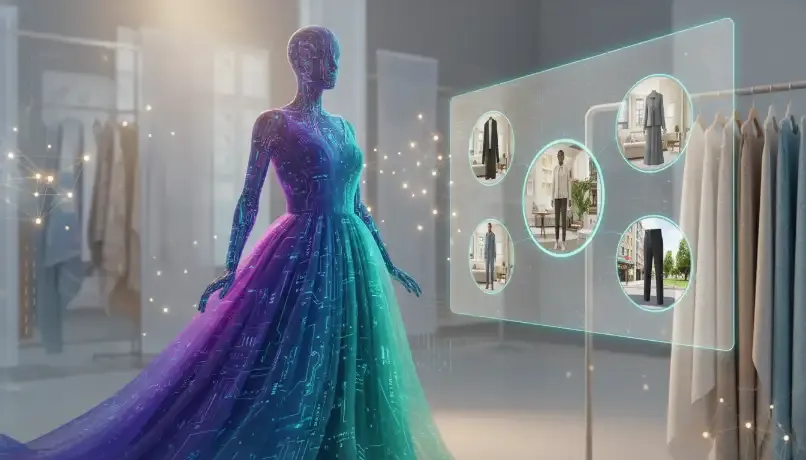
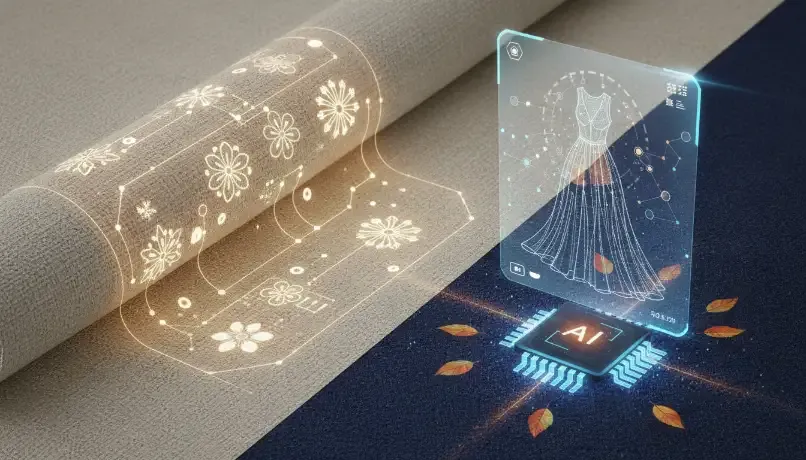
The textile and fashion industry is undergoing its biggest transformation in decades. From traditional sampling and manual design work, the industry is rapidly shifting toward Textile AI a smarter, faster, and more profitable way to convert fabric into finished garments using artificial intelligence.
Today, brands, manufacturers, exporters, and online sellers are no longer asking “What is textile AI?”
They are asking:
-
How can fabric to garment AI reduce cost and time?
-
Can AI generate ready-to-sell garment images without photoshoots?
-
How does textile AI compare with traditional design workflows?
This guide answers all of that and more.
What Is Textile AI?
Textile AI means using artificial intelligence (AI) to help people who work with fabric and garments do their work faster, easier, and smarter.
In earlier days, everything in textiles was done by hand:
-
Designers used pencils and paper
-
Tailors stitched many samples
-
Photoshoots were needed to show garments
-
Buyers took many days to approve designs
Today, Textile AI changes this old system.
What Textile AI Does in Simple Terms
Textile AI is like a smart computer brain that can:
-
Look at a fabric image
-
Understand the design and color
-
Imagine how the fabric will look as a garment
-
Show the final garment image on the screen
It helps in many textile and garment tasks, such as:
-
Fabric pattern analysis
AI looks at the fabric and understands prints, repeats, borders, and colors. -
Garment design generation
AI helps create kurti, shirt, dress, saree, or kidswear designs from fabric. -
Fabric-to-garment visualization
AI shows how the fabric will look after stitching, even before stitching starts. -
Digital catalogs and buyer approvals
Garment images can be shared online for fast approval. -
Product listing image creation
AI creates clean product images for online selling.
Why Textile AI Is Better Than Old Methods
Earlier:
-
Designers had to draw designs
-
Many samples were stitched
-
Fabric was wasted
-
Photoshoots cost money
Now with Textile AI:
-
No drawing is needed
-
No stitching is needed for preview
-
No fabric is wasted
-
No photoshoot is required
You simply upload a fabric image, and AI does the rest.
This is why Textile AI saves time, money, and effort.
In Simple Words (Very Easy Explanation)
Textile AI is a smart computer system that understands fabric and helps turn fabric into garment designs using technology.
Instead of:
-
Drawing by hand
-
Stitching samples again and again
AI does the thinking work and shows you the result on the screen.
Note
Textile AI does not replace tailors, designers, or workers.
It helps them work faster and make better decisions.
What Does “Fabric to Garment” Mean in Textile AI?
Fabric to garment means changing fabric into a garment design using AI, without stitching or photoshoots.
Let us understand this step by step.
Fabric to Garment Explained Simply
-
You have a fabric
-
You want to see how it will look as a kurti, shirt, or dress
-
AI shows you the final garment image
-
This happens before stitching
This full process is called fabric to garment transformation using AI.
How Fabric-to-Garment AI Works
Step 1: Fabric Image Is Uploaded
You upload a clear photo of your fabric.
This can be:
-
Cotton fabric
-
Printed fabric
-
Silk fabric
-
Embroidered fabric
Step 2: AI Studies the Fabric
The AI carefully analyzes:
-
Pattern
-
Texture
-
Color
-
Weave
-
Print size and scale
This step is important because it makes the final garment look real.
Step 3: Fabric Is Applied to a Garment Shape
The AI places the fabric on a garment model, such as:
-
Kurti
-
Shirt
-
Dress
-
Saree
The fabric flows naturally, just like real stitching.
Step 4: Final Garment Image Is Created
A ready-to-use garment image is generated that looks:
-
Clean
-
Professional
-
Realistic
What Fabric-to-Garment AI Removes
With this technology, you do not need:
-
Tailoring for samples
-
Models for photoshoots
-
Studios or cameras
-
Physical sample making
That means:
No tailoring.
No models.
No studio photography.
Only accurate, high-quality garment visuals on your screen.
Example (Easy to Understand)
Imagine you are a fabric seller in Surat.
-
You have one printed fabric
-
A buyer asks, “How will this look as a kurti?”
Without fabric-to-garment AI:
-
You stitch a sample
-
Spend time and money
-
Buyer may still reject
With fabric-to-garment AI:
-
Upload fabric image
-
Select kurti
-
Show image to buyer
-
Buyer approves faster
Tip
Use fabric-to-garment AI before stitching samples to avoid waste.
Remember
Fabric-to-garment AI helps you see the final result early, so you can make better decisions.
Quote
“Seeing the garment before stitching saves both fabric and frustration.”
Why Textile AI Is Replacing Traditional Textile Design
Traditional Workflow Problems
-
Multiple physical samples
-
High sampling and photoshoot costs
-
Slow buyer approvals
-
Excess fabric waste
-
Delayed go-to-market
Textile AI Advantages
| Traditional | Textile AI |
|---|---|
| Days or weeks | Seconds |
| Manual sketching | AI-generated |
| Physical samples | Digital preview |
| Costly photoshoots | Zero photoshoots |
| High waste | Sustainable |
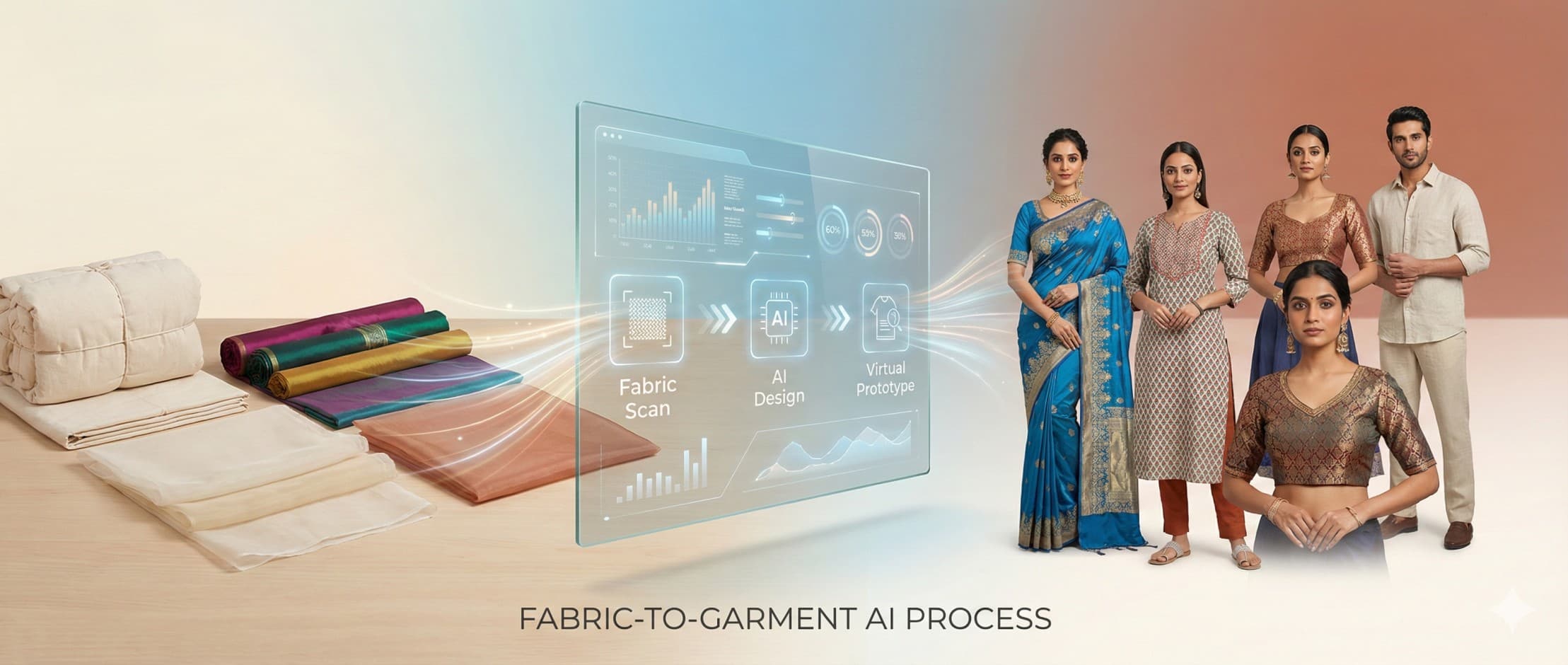
How Textile AI Fabric-to-Garment Works (Step-by-Step)
To understand Textile AI fabric-to-garment, let us break it into small, easy steps.
Think of it like cooking food:
-
You start with raw material
-
You follow steps
-
You get the final dish
Here, the raw material is fabric, and the final dish is a garment image.


Step 1: Upload the Fabric Image
The first step is very simple.
You upload a clear photo of your fabric into the Textile AI system.
This fabric can be:
-
Cotton fabric
-
Printed fabric
-
Silk fabric
-
Rayon fabric
-
Embroidered fabric
The photo should be:
-
Clear
-
Taken in good light
-
Showing full design
Tip: A clear fabric image gives a better garment result.
Step 2: Textile AI Understands the Fabric
After uploading, Textile AI studies the fabric carefully.
It looks at:
-
Fabric color
-
Print design
-
Pattern repeat
-
Border details
-
Texture and weave
-
Print size and scale
This step is like how a human designer looks at fabric and thinks:
“How will this look after stitching?”
But AI does this faster and more accurately.
Note: This step is very important.
If AI understands the fabric well, the garment image looks real.
Step 3: Choose the Garment Type
Now you select what type of garment you want.
For example:
-
Kurti
-
Shirt
-
Dress
-
Saree
-
Gown
-
Kidswear
You are telling the AI:
“Please show me how this fabric will look as this garment.”
Remember: One fabric can be used to create many garment designs.
Step 4: Fabric Is Applied to the Garment Shape
Now the magic happens.
The AI:
-
Places the fabric on the garment shape
-
Adjusts folds and flow
-
Matches fabric direction
-
Keeps print alignment correct
The fabric looks like it is actually stitched, even though it is not.
This is called fabric-to-garment visualization.
Step 5: AI Creates a Realistic Garment Image
After placing the fabric, the AI creates a final garment image.
This image looks:
-
Clean
-
Professional
-
Natural
-
Ready for selling
It includes:
-
Proper lighting
-
Natural fabric fall
-
Real-like appearance
There is no drawing, no stitching, and no photoshoot involved.
Step 6: Garment Image Is Ready to Use
Now the garment image is ready.
You can use it for:
-
Buyer approval
-
Digital catalogs
-
WhatsApp sharing
-
Website product listing
-
Online selling
Tip: Use these images before production to avoid mistakes.
What Textile AI Removes from the Process
With fabric-to-garment AI, you do not need:
-
Tailoring samples
-
Models for photoshoot
-
Studio setup
-
Camera equipment
-
Repeated sample changes
That means:
No tailoring.
No models.
No studio photography.
Only smart digital garment images.
Textile AI for Digital Catalogs & Buyer Approvals
In the textile business, showing your product clearly is just as important as making it.
Buyers do not buy fabric only they buy how the final garment will look.
This is where Textile AI for digital catalogs and buyer approvals becomes very powerful.
One of the biggest advantages of fabric to garment AI is digital textile catalogs.
Instead of sending fabric swatches or physical samples, sellers can now share:
-
Fabric-based garment previews
-
Multiple colorways
-
Multiple styles from the same fabric
Buyers can approve designs before production, saving weeks of back-and-forth.
What Is a Digital Textile Catalog?
A digital textile catalog is an online collection of garment images made using Textile AI.
Instead of:
-
Heavy physical files
-
Printed catalogs
-
Fabric swatch books
You get:
-
Clear garment images
-
Easy sharing on mobile
-
Fast updates anytime
In simple words:
A digital textile catalog shows how your fabric looks as a finished garment on a screen.
How Digital Catalogs Worked Earlier (Old Method)
Earlier, making a catalog was difficult:
-
Fabric samples were stitched
-
Photoshoots were arranged
-
Models were hired
-
Printed catalogs were made
-
Changes took many days
If a buyer said “no”:
-
Sample was wasted
-
Time was lost
-
Money was lost
How Textile AI Changes Digital Catalogs (New Method)
With Textile AI, digital catalogs are made easily.
You can:
-
Upload fabric images
-
Generate garment designs
-
Create many styles from one fabric
-
Update catalog anytime
No printing.
No re-shoots.
No waste.
Step-by-Step: Creating a Digital Textile Catalog Using AI
Step 1: Upload Fabric Images
Upload clear photos of your fabric designs.
Step 2: Generate Garment Images
Textile AI converts fabric into:
-
Kurti images
-
Shirt images
-
Dress images
Step 3: Organize the Catalog
Images are arranged neatly:
-
By fabric type
-
By garment style
-
By color
Step 4: Share Digitally
Catalog can be shared using:
-
WhatsApp
-
Email
-
Website
-
Online meetings
Why Buyers Like Digital Textile Catalogs
Buyers today prefer fast and clear communication.
With AI-based digital catalogs:
-
Buyers see final garment look
-
No need to imagine from fabric
-
Easy to compare designs
-
Faster decision making
Remember:
Buyers approve faster when they see clearly.
What Is Buyer Approval in Textile Business?
Buyer approval means:
-
Buyer checks the design
-
Buyer agrees to produce it
-
Production starts
Earlier, this process took:
-
Many samples
-
Many changes
-
Many days
How Textile AI Improves Buyer Approvals
With fabric-to-garment AI:
-
Buyer sees garment before stitching
-
Changes are done digitally
-
No physical resampling
-
Approval time reduces
Instead of saying:
“Let us stitch and see”
Buyer can say:
“Yes, this looks good. Go ahead.”
Example (Very Easy to Understand)
Imagine a fabric manufacturer in Surat.
-
He sends only fabric photos
-
Buyer cannot imagine final garment
-
Buyer delays approval
Now with Textile AI:
-
Fabric is converted into kurti images
-
Buyer sees neckline, length, flow
-
Buyer approves in one call
Result:
Faster approval and faster order.
Textile AI for Online Selling & Marketplaces
If you sell on:
-
Meesho
-
Amazon
-
Flipkart
-
Shopify
-
Custom D2C websites
Textile AI solves a massive problem: product images.
With Textile AI, you can:
-
Generate listing images without photoshoots
-
Create uniform catalog visuals
-
Launch products faster
-
Test designs before manufacturing
This is why textile AI is becoming essential for modern fashion eCommerce.
Modern textile AI platforms go further by offering:
-
True fabric-to-garment realism
-
Marketplace-ready images
-
Production-aligned visuals
-
Business-first workflows (not just designers)
Why Fabric-to-Garment AI Is Critical for Manufacturers
Manufacturers lose money in:
-
Sampling
-
Design rejections
-
Unsold inventory
Fabric to garment AI allows manufacturers to:
-
Validate demand before production
-
Show buyers multiple options instantly
-
Reduce dead stock
-
Improve profit margins
This shifts textile businesses from reactive to data-driven.
Sustainability Benefits of Textile AI
Textile AI is not just fast it’s sustainable.
-
Fewer physical samples
-
Reduced fabric waste
-
Less water usage
-
Lower carbon footprint
AI-based design previews align perfectly with eco-friendly manufacturing goals.
Who Should Use Textile AI?
Textile AI is ideal for:
-
Fabric manufacturers
-
Garment exporters
-
Boutique owners
-
Fashion startups
-
D2C brands
-
Marketplace sellers
-
Buying houses
If you deal with fabric, garments, or fashion sales, textile AI is no longer optional.
The Future of Textile AI & Fabric-to-Garment Technology
The future of textile AI includes:
-
AI-generated videos from garments
-
Buyer-specific customization
-
Virtual try-on integration
-
Automated tech-pack generation
-
AI-driven demand forecasting
Fabric-to-garment AI will soon become the industry standard, not a premium feature.
Final Thoughts: Why Textile AI Is the New Foundation of Fashion
Textile AI is not just a tool it’s a complete transformation of how fashion products are designed, approved, and sold.
By combining fabric to garment AI, digital catalogs, and marketplace-ready visuals, textile businesses can:
-
Move faster
-
Spend less
-
Sell smarter
The brands that adopt textile AI today will dominate tomorrow’s textile and fashion market.