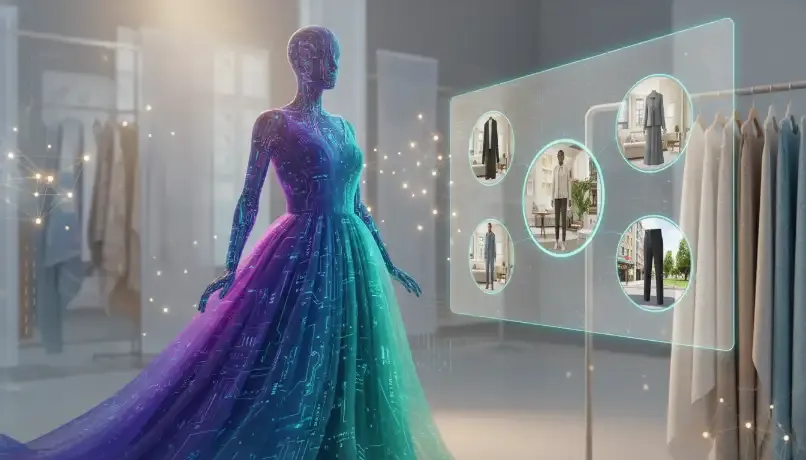
Imagine If Your Customers Could Try Clothes Without Touching Them
What if your customer could wear your product without going to a store?
What if they could see how a shirt, dress, kurti, or glasses look on their own body in just seconds?
This is not the future. This is happening now.
Virtual try on is changing the way the global textile market, e-commerce brands, D2C sellers, and manufacturers do business. If you sell clothes, eyewear, or fashion products, this technology can completely change your growth story.
This guide will explain everything in simple language. You will understand what virtual try on is, how it works, why it matters, and how you can use it for your brand.
But most importantly, you will see how you can start using it today.
How Textile AI Can Help You Grow Faster
If you are thinking, “This sounds powerful, but how do I actually use it?” this is where TheTextileAI helps you.
TheTextileAI provides an advanced virtual try on solution specially designed for:
-
E-commerce brands
-
D2C clothing brands
-
Textile manufacturers
-
Fashion retailers
-
Global sellers
Instead of building complex AI systems from scratch, you can use a ready virtual try on tool built for the fashion industry.
Here is how it helps you:
1. Turn Your Product Images into Interactive Try-On Experiences
You already have product photos.
TheTextileAI transforms those photos into virtual try on experiences.
Customers can:
-
Upload their image
-
Use a live camera
-
See the product placed naturally on their body
This increases customer confidence instantly.
Tip: Products with interactive features get more attention than static images.
2. Reduce Returns and Increase Conversion
When shoppers clearly see how your product looks on them, they make better decisions.
This means:
-
Fewer size-related returns
-
Fewer style mismatches
-
Higher purchase confidence
Remember: Every reduced return saves shipping cost, packaging cost, and time.
Better visualization equals better business performance.
3. Improve Customer Engagement
TheTextileAI virtual try on tool keeps users engaged longer on your website.
When customers interact with your product:
-
They explore more
-
They compare styles
-
They stay longer on your store
Longer engagement often leads to higher conversion rates.
Quote: “Engaged customers do not just browse. They buy.”
4. Perfect for Global Textile and E-Commerce Sellers
If you sell internationally, virtual try on becomes even more powerful.
Customers in different countries can:
-
See how styles suit them
-
Test different designs instantly
-
Feel confident before ordering
This reduces cross-border return problems and builds trust globally.
Note: International returns are more expensive. Prevention is better than refund.
See It in Action Live Demo
You do not have to imagine how it works.
You can experience the demo here:
https://www.thetextileai.com/ai-tool/virtual-try-on
In the demo section, you can:
-
Upload a model image
-
Add your garment
-
See realistic AI-powered results
This shows how easily your brand can offer virtual try on without complicated development.
Tip: Before integrating any new technology, always test the demo yourself. Experience it like your customer would.
Why This Matters for Your Brand
Today’s customers expect modern shopping experiences.
They use filters on social media.
They use face effects in apps.
They are comfortable with AR and AI tools.
If your website only shows flat product images, you are missing a big opportunity.
Virtual try on through TheTextileAI allows you to:
-
Look innovative
-
Build stronger trust
-
Differentiate from competitors
-
Offer a premium shopping experience
Remember: The brands that adopt technology early usually lead the market.
What Is Virtual Try On?
Virtual try on is a smart digital technology that allows people to see how clothes, eyewear, or fashion accessories look on their own body using a mobile phone, tablet, or computer. Instead of imagining how a dress, kurti, shirt, or glasses might look, customers can actually see a realistic preview before buying.
This technology uses:
-
AI try on technology
-
AR try on (Augmented Reality)
-
Smart image processing and body detection
When a customer uploads a photo or turns on their live camera, the system scans their face or body shape. Then, virtual try on technology places the selected product on their image in a natural and realistic way. The clothing adjusts to body posture. Eyewear aligns with the eyes. The size and position are calculated automatically.
This is not simple photo editing. It is intelligent technology that understands body structure, angles, and proportions.
For example:
-
A customer tries a kurti online and sees how the color and design look on her body.
-
A shopper uses eyeglasses virtual try on to test different frames on their face in seconds.
-
A buyer checks virtual try on eyeglasses before ordering to make sure the frame suits their face shape.
Instead of guessing, customers can see the result clearly.
Tip: When customers see the product on themselves, their confidence increases. Higher confidence leads to faster buying decisions.
Note: Visual clarity is one of the biggest decision factors in online shopping.
Remember: In online fashion, people do not buy only a product. They buy how they look in that product.
Virtual try on makes online shopping more personal, interactive, and realistic. It removes doubt and replaces it with visual proof.
Quote: “Seeing creates believing. Believing creates buying.”
Why Virtual Try On Is Important for the Global Textile Market
The global textile and fashion industry is one of the largest industries in the world. It includes manufacturers, wholesalers, retailers, D2C brands, designers, and online sellers across many countries.
According to Statista, the global apparel market is expected to cross 1.7 trillion USD by 2027 (Source: Statista – Apparel Market Revenue Worldwide). This shows how massive and competitive the industry is.
At the same time, online shopping is growing very fast. More people now prefer buying clothes online instead of visiting physical stores. Smartphones and fast internet have made e-commerce simple and accessible.
But there is a serious challenge.
In physical stores, customers can:
-
Touch the fabric
-
Check the fitting
-
See the real color
-
Try different sizes
In online shopping, they cannot do these things physically.
This creates common problems such as:
-
Size confusion
-
Style mismatch
-
Wrong color expectations
-
High product returns
According to the National Retail Federation (NRF), return rates in e-commerce can reach around 20% to 30%, especially in apparel (Source: NRF Retail Reports). Apparel has one of the highest return rates among online categories.
High returns create big problems for businesses:
-
Extra shipping costs
-
Inventory management issues
-
Product damage during return
-
Lower profit margins
This is where virtual try on becomes very important for the global textile market.
Virtual try on helps in three powerful ways:
It reduces guesswork.
Customers no longer guess how a product will look. They see it clearly.
It increases trust.
When shoppers can preview items on their own body or face, they feel more confident.
It reduces returns.
Better visualization means fewer wrong purchases.
Tip: If you are a textile manufacturer or seller, fewer returns directly increase your profit margins.
Note: Returns are not just a logistics problem. They are a profitability problem.
Remember: In online fashion, clarity equals confidence, and confidence equals conversion.
Virtual try on is not just a modern feature. It is becoming a business necessity for global sellers who want to stay competitive in today’s digital textile market.
Quote: “In digital commerce, the brands that show more will sell more.”
For textile brands, e-commerce sellers, and global fashion businesses, virtual try on is not only about technology. It is about solving real customer problems and building long-term trust.
How Virtual Try On Works (Simple Explanation)
Let us break it into easy steps.
Step 1: The customer uploads a photo or turns on their camera.
Step 2: AI detects body shape, face, or posture.
Step 3: The product image is mapped correctly on the body.
Step 4: The customer sees a realistic preview.
This is AI try on technology.
In AR try on, the camera shows the product in real time.
For example:
-
Virtual eyewear try on places glasses on the face.
-
Fashion try on places dresses, shirts, or sarees on the body.
It feels real. But it is digital.
Types of Virtual Try On in Fashion
1. Clothing Virtual Try On
This is used by:
-
E-commerce brands
-
D2C clothing brands
-
Textile manufacturers
Customers can see:
-
How the outfit fits
-
How the color looks
-
How the style matches their body
This increases buying confidence.
2. Eyeglasses Virtual Try On
Eyewear brands use virtual try on eyeglasses to let customers test frames online.
Grand View Research reports that the global augmented reality market is expected to grow significantly, driven by retail and e-commerce adoption (Source: Grand View Research – AR Market Report).
Virtual eyewear try on is one of the fastest growing use cases.
3. Accessories and Fashion Items
Online try on also works for:
-
Hats
-
Jewelry
-
Bags
-
Scarves
The goal is simple: show the product on the customer.
Why E-Commerce Brands Must Use Virtual Try On
If you run an online store, you face these problems:
-
High returns
-
Low conversion rate
-
Cart abandonment
-
Customer doubts
Virtual try on technology solves these problems.
1. Increases Conversion Rate
When customers see the product on themselves, they feel confident.
They click buy faster.
Shopify reports that interactive shopping experiences increase engagement and sales (Source: Shopify Commerce Trends Report).
2. Reduces Returns
When size and style are clear, returns reduce.
Remember: Every return costs money in shipping, packaging, and handling.
Lower returns mean higher profit.
3. Builds Brand Trust
Customers trust brands that use modern technology.
Virtual try on shows that your brand is innovative.
How D2C Clothing Brands Benefit
D2C brands compete with big players.
They need differentiation.
Virtual try on gives them:
-
A premium shopping experience
-
Better customer engagement
-
Stronger brand image
Tip: If you are a D2C seller, use virtual try on as a marketing tool. Show demo videos in ads. Customers love interactive features.
Benefits for Textile Manufacturers
Many textile manufacturers think this technology is only for retailers.
This is not true.
Manufacturers can use:
-
AI try on technology for sampling
-
Digital catalogs
-
B2B presentations
Instead of sending physical samples, you can show digital try-on previews.
Note: This reduces production waste and speeds up decision making.
Real Statistics That Prove the Power
Here are important numbers:
-
Around 70% of online shoppers say product visualization affects their buying decision (Source: Shopify Research).
-
High return rates in apparel can go above 25% (Source: National Retail Federation).
-
The global AR market is projected to grow rapidly in the coming years, especially in retail (Source: Grand View Research).
These numbers show one thing clearly.
Virtual try on is not optional anymore.
It is becoming necessary.
Common Problems in Online Fashion Shopping
Let us understand customer pain points.
-
"Will this fit me?"
-
"Will this color suit me?"
-
"Is this frame too big for my face?"
-
"What if I do not like it after delivery?"
Virtual try on solves these questions before purchase.
Quote: "Confidence is the biggest driver of online fashion sales."
When customers feel sure, they buy more.
How AI Try On Technology Is Different from Simple Photo Editing
Many people think this is just Photoshop.
It is not.
AI try on technology:
-
Detects body parts
-
Understands posture
-
Adjusts product size
-
Matches lighting
This creates a more realistic experience.
Simple overlays cannot do this.
Remember: Accuracy matters. If the preview looks fake, customers will not trust it.
How Virtual Try On Helps Global Sellers
If you sell internationally, you face:
-
Different body types
-
Different style preferences
-
Higher shipping costs
Virtual try on helps customers decide correctly before ordering across borders.
This reduces:
-
International returns
-
Negative reviews
-
Refund requests
Tip: If you are targeting global markets, add size guides and virtual try on together. This increases clarity.
How to Implement Virtual Try On in Your Business
Now let us talk about action.
Step 1: Choose the right virtual try on technology provider.
Step 2: Integrate it into your website or app.
Step 3: Optimize product images for quality.
Step 4: Promote the feature clearly.
Note: Do not hide the feature. Highlight it on product pages.
Example:
"Try Before You Buy – Use Virtual Try On Now."
Marketing Strategy Using Virtual Try On
You can use it in:
-
Social media ads
-
Landing pages
-
Email campaigns
-
Influencer collaborations
Show customers how easy it is.
People share interactive experiences.
This increases organic growth.
Challenges and Things to Remember
Virtual try on is powerful, but you must:
-
Ensure accurate product images
-
Maintain data privacy
-
Optimize website speed
Remember: Slow loading technology can hurt user experience.
Always test before full launch.
Future of Virtual Try On in Fashion
The future will include:
-
Real-time body measurement
-
AI styling suggestions
-
Personalized outfit combinations
-
Virtual fashion shows
According to multiple retail technology reports, AI and AR will continue to grow in digital commerce adoption over the next decade.
This means early adopters will gain an advantage.
Action Plan for You
If you are:
E-commerce Brand
Start testing virtual try on on top-selling products.
D2C Clothing Brand
Use it as a brand positioning tool.
Textile Manufacturer
Offer digital samples to buyers.
Global Seller
Reduce return rates with better visualization.
Ask yourself:
Are your customers guessing?
Or are they seeing?
That answer will decide your growth.