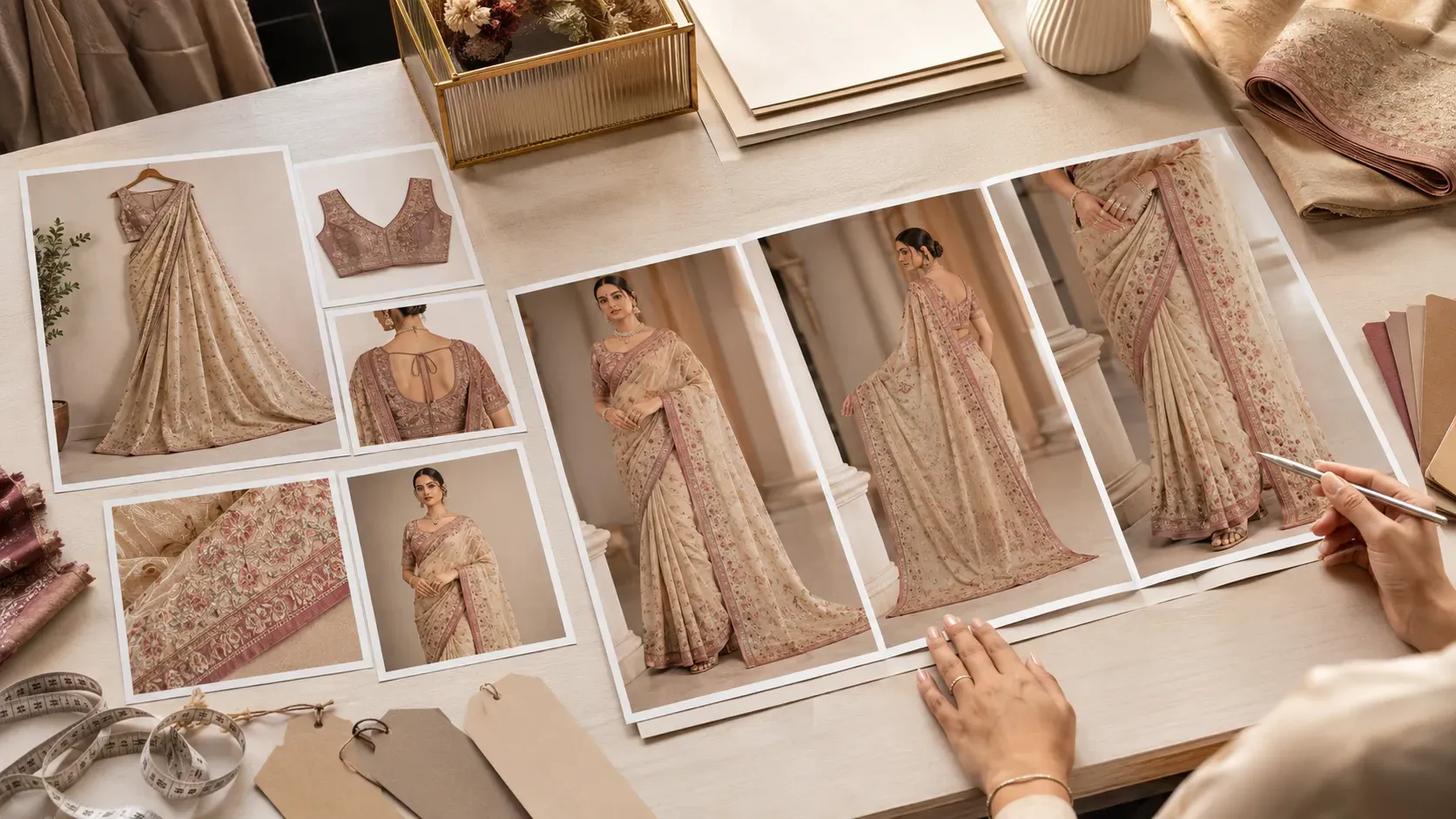
Saree selling is highly visual.
A saree may have a beautiful color, premium border, rich pallu, detailed blouse work, soft fabric fall, and elegant pattern. But if the customer cannot see how it looks when worn, the product may not create enough confidence online.
This is a common problem for saree e-commerce sellers.
Flat saree photos are useful because they show the actual fabric, color, border, and pallu. But most customers want more than that. They want to see the final draped look. They want to understand how the saree appears on a model, how the pallu falls, how the pleats look, how the blouse matches, and how premium the full outfit feels.
Traditional saree photoshoots can solve this, but they are expensive and time-consuming.
A seller needs a model, photographer, saree draping expert, blouse styling, lighting, studio, background, editing, and multiple poses. If the seller has hundreds of sarees, creating catalog photos for every product becomes difficult.
This is where AI Saree Catalog Generation becomes useful.
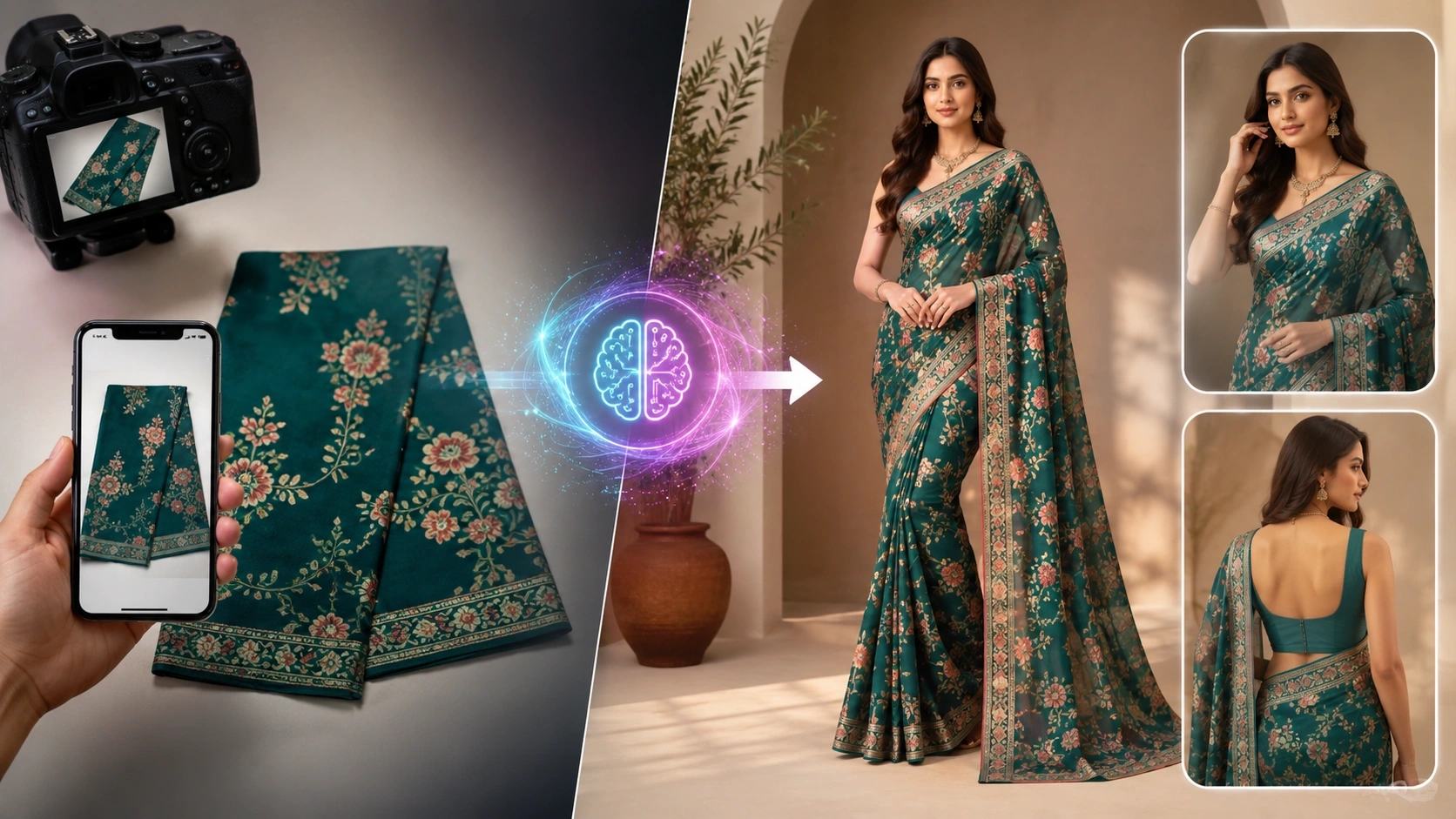
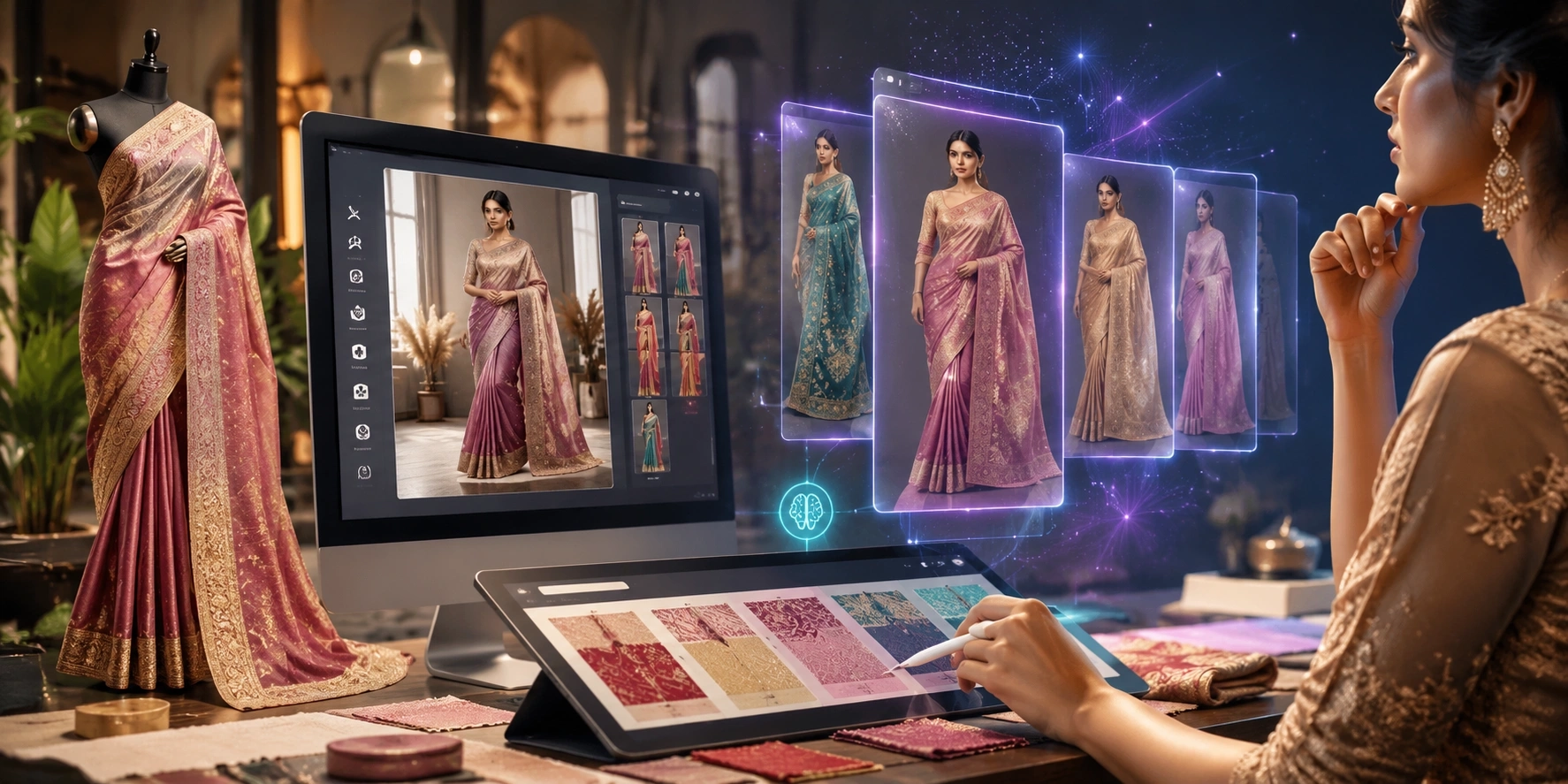
AI saree catalog generation helps e-commerce sellers convert raw saree photos into model-worn catalog images using artificial intelligence. Instead of arranging a full photoshoot for every saree, sellers can upload saree assets, configure image count and aspect ratio, add custom instructions, and generate catalog-style visuals faster.
The Textile AI Saree Drape E-commerce Studio is built for this workflow.
Website:
https://www.thetextileai.com/ai/tools/saree-drape-e-commerce-studio
What is AI Saree Catalog Generation?
AI Saree Catalog Generation is the process of using artificial intelligence to create professional saree catalog images from raw saree references.
In simple words, it helps turn a flat, folded, hanger, or raw saree photo into a model-worn saree image.
The AI studies the saree color, border, pallu, pleats, blouse details, fabric texture, pattern scale, and drape style. Then it creates a realistic catalog visual where the saree appears worn by a model.
This is useful for e-commerce because customers understand sarees better when they see them draped.
A raw saree photo shows the product material. A model-worn catalog image shows the final look.
Both are important, but for online selling, the model-worn image often creates stronger product appeal.
“A raw saree photo shows the fabric. A model-worn saree image shows the buying imagination.”
Why E-Commerce Sellers Need Saree Catalog Images
Online customers cannot touch the saree. They cannot feel the fabric, check the fall, or try the drape physically. They depend on images.
This makes catalog images very important.
A good saree catalog image helps customers understand how the product will look in real use. It shows the saree as a complete outfit, not just as fabric.
For saree e-commerce sellers, this can improve product presentation on Shopify stores, marketplaces, Instagram shops, WhatsApp catalogs, boutique websites, and buyer presentations.
A strong catalog image can show the full saree drape, pallu fall, pleat structure, border placement, blouse design, fabric texture, styling mood, and premium look of the saree.
When customers can see these details clearly, they feel more confident about the product.
Remember: In saree e-commerce, the image does not only display the saree. It helps the customer imagine wearing it.
The Problem with Traditional Saree Photoshoots
Traditional saree catalog photography is not simple.
A saree photoshoot needs careful draping. The pleats should look clean. The pallu should fall properly. The border should be visible. The blouse design should match the saree. The model pose should look elegant. The lighting should show the fabric and details clearly.
This needs skill and time.
For one saree, the process may be manageable. But for a seller who has 50, 100, or 500 sarees, traditional photoshoots become slow and expensive.
The cost can include model fees, studio charges, photographer cost, draping expert, makeup, styling, editing, retouching, and catalog formatting. If the seller wants multiple poses, the cost increases more.
This becomes a challenge for small boutiques, saree manufacturers, wholesalers, Shopify sellers, Instagram sellers, and textile businesses that launch new collections regularly.
AI saree catalog generation helps reduce this pressure.
It allows sellers to create model-worn saree previews without arranging a full studio shoot for every product.
Tip: Use AI catalog images for fast product presentation, then use real photoshoots only for selected hero products or premium campaigns.
How The Textile AI Saree Drape E-Commerce Studio Works
The Textile AI Saree Drape E-commerce Studio is designed to help sellers create saree catalog images from saree assets.
The workflow is simple.
First, the seller uploads the primary raw saree photo. This image is required because it tells the AI the main saree color, border, design, pallu, and overall look.
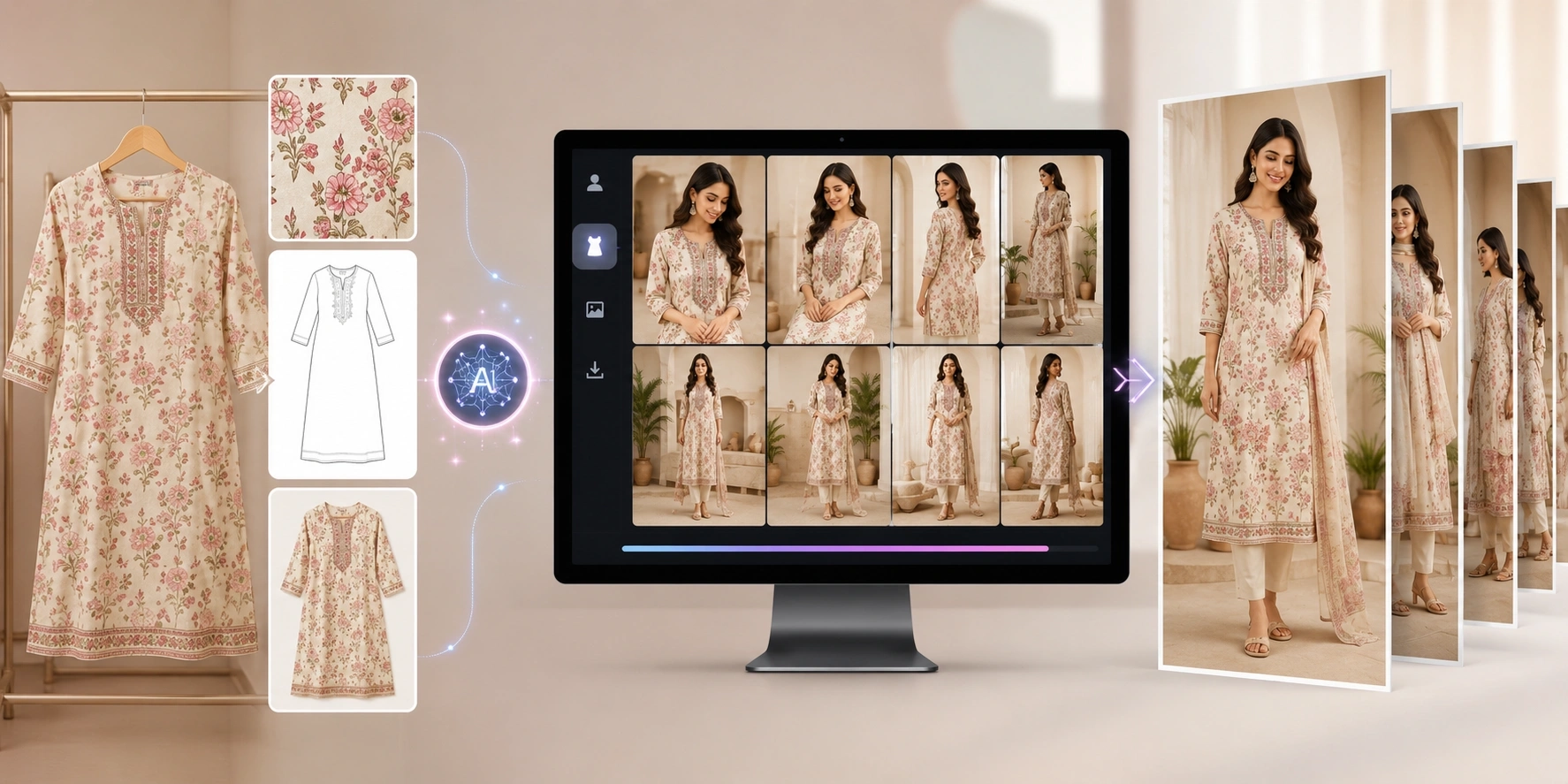
Then the seller can upload optional detail references like blouse front, blouse back, zoomed material pattern, and model or face reference. These optional inputs help guide the AI more accurately.
After uploading assets, the seller configures the number of catalog images, chooses aspect ratio, and adds custom instructions if needed.
Then the AI generates model-worn saree catalog images while following quality safeguards such as keeping the original color, preserving exact border detail, matching blouse design, and avoiding added embroidery.
This makes the tool useful for sellers who want faster saree catalog creation with better design control.
Website:
https://www.thetextileai.com/ai/tools/saree-drape-e-commerce-studio
Raw Saree Photo
The raw saree photo is the most important input.
This is required because the AI needs to understand the saree design before creating a draped output. The raw saree photo can be a folded view, hanger view, or flat view, as long as it clearly shows the colors and border.
A clear raw saree photo helps the AI understand the main product details.
If the saree has a special border, pallu design, butti pattern, woven texture, or color variation, those details should be visible in the image.
A poor input image can affect the output. If the saree is blurry, too dark, overexposed, heavily folded, or unclear, the AI may not capture the design properly.
Remember: The raw saree photo is the base of the entire catalog generation process. Better input gives better output.
Blouse Front Reference
The blouse front reference is optional, but it is very useful when blouse design matters.
Many sarees come with special blouse work. The blouse may have embroidery, stone work, neckline design, sleeve border, printed pattern, or matching fabric details. Customers often look at blouse styling because it completes the saree look.
Uploading a blouse front reference helps the AI understand front embroidery, neck cut style, sleeve design, and blouse pattern.
This is helpful for designer sarees, party wear sarees, festive sarees, boutique collections, and premium ethnic wear products.
If the blouse front is important for the product, sellers should upload this reference.
Tip: For premium sarees, always provide blouse front reference if available. It helps the final catalog image look more accurate and complete.
Blouse Back Reference
The blouse back reference is also optional, but it is important for back-view catalog images.
Many modern saree blouses have deep necklines, hook placements, tie-ups, border finishing, back embroidery, stone work, or special layout details. If the seller wants accurate back-side visuals, the blouse back reference can guide the AI.
This helps create more complete product galleries.
A customer may want to see how the blouse looks from the back, especially for fashion-forward sarees, designer sarees, bridal sarees, and boutique pieces.
Uploading blouse back reference can help the AI replicate back hook placement or back layout design more properly.
“A complete saree catalog should show not only the saree, but also the blouse design that completes the look.”
Zoomed Pattern or Material Reference
The zoomed pattern reference helps preserve fine details.
A full saree image may not show the small fabric details clearly. Borders, embroidery, zari, weaving, butti motifs, stone work, lace, and texture can get lost in a full view.
That is why a zoomed material image is helpful.
The AI can use the zoomed pattern reference to understand fine weave pattern scale, border richness, material texture, shine, and decorative work.
This is especially important for heavy work sarees, zari borders, premium silk sarees, embroidered sarees, stone work sarees, printed sarees, and detailed pallu designs.
For e-commerce, close detail matters because customers often judge quality from visible fabric work.
Remember: A zoomed pattern image helps AI understand the saree details that a full photo may not show clearly.
Model or Face Reference
The model or face reference is optional, but it can be powerful for brand consistency.
If a seller wants the saree to be draped on a specific model, they can upload a model or face reference. This helps the AI preserve the model’s face and identity while generating the saree catalog image.
This is useful for brands that want a consistent model style across their product catalog.
A Shopify store or saree brand may want all product images to look visually connected. If every image has a completely different model face, pose, and styling, the catalog may look inconsistent.
A model reference can help create a more uniform brand look.
Tip: Use a model reference when you want consistent catalog identity across multiple sarees.
Number of Catalog Images
Different saree sellers need different image counts.
Some sellers may need only one pose for a quick product preview. Some may need multiple poses for a complete product gallery.
The Textile AI Saree Drape E-commerce Studio allows users to choose the number of catalog images, such as 1 pose, 2 poses, 3 poses, 4 poses, or 6 poses.
The 3-pose option is recommended because it gives enough variety for a basic product gallery without becoming too heavy.
A good saree listing may include a full front pose, side or pallu pose, and detail-focused pose. For premium products, more poses can be useful.
For e-commerce, multiple images can help customers understand the saree better.
Remember: One image can show the product, but multiple poses can explain the full saree look.
Aspect Ratio Options
Aspect ratio is important because saree images are used across different platforms.
A Shopify product page may need a portrait ratio. Instagram may need a square or vertical ratio. Website banners may need wide ratios. Marketplace listings may have their own image requirements.
The tool supports multiple aspect ratios such as 2:3, 3:4, 4:5, 9:16, 1:1, 3:2, 16:9, and auto.
This gives sellers flexibility.
For saree product listings, portrait ratios like 3:4 and 4:5 are usually useful because they show the full model-worn look clearly. For social media stories or reels covers, 9:16 can be useful. For website banners, 16:9 can work better.
Tip: Choose the aspect ratio based on where the image will be used. Product pages, Instagram posts, stories, and banners need different framing.
Custom Instructions
Custom instructions help sellers guide the final output.
A seller can specify background aesthetic, lighting style, model posing preference, drape detail, or catalog mood.
For example:
Create a clean e-commerce saree catalog image with elegant model pose, soft studio lighting, visible pallu, neat pleats, and accurate border placement.
This helps the AI understand the exact visual direction.
Custom instructions are especially helpful when sellers want a specific look, such as premium studio background, simple catalog style, festive mood, minimal jewelry, natural lighting, or close-up pallu detail.
The instructions should be clear and direct.
“A good saree catalog prompt tells the AI what to show clearly and what details must stay unchanged.”
Strict Quality Safeguards
Saree catalog generation must be accurate.
If AI changes the saree color, border, blouse design, or embroidery, the output may mislead customers. That is why quality safeguards are important.
The Textile AI Saree Drape E-commerce Studio includes strict quality safeguards such as original color kept, exact border detail, matching blouse design, and no added embroidery.
These safeguards help preserve the identity of the uploaded saree.
For saree sellers, this is very important because customers buy based on exact product appearance. The border, blouse, color, pallu, and embroidery must stay close to the reference.
AI should improve presentation, not invent a new product.
Remember: Saree catalog images should look premium, but they must still represent the actual saree accurately.
How AI Saree Catalog Generation Helps Shopify Sellers
Shopify saree stores need professional product images.
A customer visiting a Shopify product page may quickly decide whether the saree looks attractive. If the product image is only a flat folded saree photo, the customer may not understand the full look.
AI saree catalog generation helps Shopify sellers create model-worn product images faster.
These images can be used for product pages, collection pages, homepage sections, social media ads, WhatsApp catalogs, email campaigns, and festive launch pages.
A product page with model-worn saree images looks more complete. It helps customers see the final drape, pallu, pleats, blouse, and full outfit styling.
This can make the store look more professional.
Tip: Use AI-generated model-worn saree images as main product visuals and keep real fabric close-ups as supporting images.
How AI Helps Saree Manufacturers
Saree manufacturers often handle large collections.
They may produce many colors, borders, materials, and patterns. Creating real photoshoots for every saree can slow down the sales process.
AI helps manufacturers create quick catalog previews.
They can show buyers how a saree may look when worn, even before arranging a full shoot. This is useful for wholesale catalogs, retailer presentations, buyer approvals, export presentations, and new collection previews.
Instead of sending only raw saree photos, manufacturers can send model-worn catalog previews.
This makes the collection look more attractive and easier to understand.
Remember: Manufacturers can use AI to present large saree collections faster and more professionally.
How AI Helps Boutiques and Instagram Sellers
Boutiques and Instagram sellers need strong visuals to attract customers.
Many customers ask how a saree will look after draping. They may like the fabric but hesitate because they cannot imagine the final look.
AI saree catalog generation helps sellers answer visually.
A boutique can upload a raw saree image and create a model-worn preview. An Instagram seller can use the generated image as the first product post. WhatsApp sellers can share AI catalog images with customers to explain the product better.
This is especially useful for sellers who do not have time or budget for regular photoshoots.
For small sellers, AI makes catalog creation more accessible.
“AI helps small saree sellers present products like a professional catalog brand.”
AI Saree Catalog Images vs Traditional Photoshoots
AI saree catalog generation and traditional photoshoots both have value.
Traditional photoshoots are useful for premium campaign shoots, influencer content, celebrity marketing, final brand storytelling, and high-end product launches.
AI saree catalog generation is useful for speed, scale, product previews, Shopify listings, social media posts, wholesale catalogs, and daily selling content.
A smart saree brand can use both.
Use AI to create quick catalog images for many products. Use traditional photography for selected hero products and premium campaigns.
This gives the brand a balanced workflow.
Tip: Use AI for catalog scale and traditional photoshoots for brand storytelling.
How AI Reduces Catalog Creation Cost
Traditional saree catalog creation can be expensive because it requires many people and resources.
Every saree may need draping, model posing, photography, editing, and formatting. If the seller wants multiple poses, the cost increases.
AI helps reduce this cost by creating catalog images digitally.
A seller can generate 1, 2, 3, 4, or 6 poses depending on the requirement. Each generation uses credits, making the process easier to plan.
This is useful for businesses that want professional visuals without arranging repeated shoots.
AI does not remove all costs, but it can reduce the cost of repeated catalog creation.
Remember: AI helps reduce photoshoot dependency, especially for regular product listings.
How AI Improves Buyer Confidence
Customers feel more confident when they understand the product clearly.
A flat saree photo may show fabric, but a model-worn catalog image shows how the saree may look in real use.
This helps answer important questions:
- How does the pallu fall?
- How do the pleats look?
- How does the border appear on the body?
- How does the blouse match?
- How premium does the full saree look?
When customers get visual answers, their hesitation can reduce.
A clear catalog image makes the product page stronger and more useful.
“Better saree visuals reduce doubt. Less doubt can support faster buying decisions.”
Best Use Cases for AI Saree Catalog Generation
AI saree catalog generation can support many e-commerce and business workflows.
It can be used for Shopify product pages, Instagram posts, WhatsApp catalogs, marketplace listings, wholesale buyer PDFs, festive campaigns, boutique product previews, new collection lookbooks, social media ads, product gallery images, and website banners.
It is also useful for color variant testing, product launch planning, catalog refresh, and buyer presentation.
The most common use cases include:
- Creating model-worn saree catalog images
- Showing pallu and pleats clearly
- Showing blouse front and back details
- Preparing Shopify product gallery visuals
- Creating Instagram-ready saree posts
- Building WhatsApp catalog images
- Preparing wholesale buyer presentations
- Creating festive collection visuals
- Reducing dependency on repeated photoshoots
Common Mistakes to Avoid
AI saree catalog generation works best when input references are clear.
One common mistake is uploading a poor raw saree image. If the saree photo is blurry, dark, overexposed, or does not show the border properly, the output may not be accurate.
Another mistake is skipping blouse references when blouse design is important. If the saree has a special blouse front or back, uploading references can improve the result.
Sellers should also avoid vague custom instructions. Clear instructions help the AI generate better catalog images.
Most importantly, sellers should review generated images before publishing. Check the saree color, border, pallu, pleats, blouse, embroidery, and overall realism.
Remember: AI can create saree catalog images faster, but quality checking should still stay with the seller.
How to Get Better Results
To get better AI saree catalog results, start with a clear raw saree photo. Make sure the color, border, pallu, and fabric details are visible.
Upload blouse front and blouse back references if available. Add zoomed pattern or material references when the saree has detailed weave, embroidery, zari, stone work, or special border.
Use model reference if you want consistent face or model identity.
Choose the right image count and aspect ratio based on your platform. For Shopify product pages, portrait ratios like 3:4 or 4:5 are useful. For Instagram stories, 9:16 works better. For banners, 16:9 can be used.
Write custom instructions clearly.
For example:
Create a premium saree catalog image with clean background, elegant model pose, visible pallu, neat pleats, accurate blouse design, and original saree color.
Tip: Good references and clear instructions create better catalog outputs.
Why The Textile AI Saree Drape E-Commerce Studio is Useful
The Textile AI Saree Drape E-commerce Studio is useful because it is designed specifically for saree sellers and ethnic wear businesses.
It supports raw saree photo upload, blouse front reference, blouse back reference, zoomed pattern reference, model or face reference, multiple catalog image counts, many aspect ratios, custom instructions, and strict quality safeguards.
This makes it practical for saree brands that need professional catalog visuals faster.
A Shopify saree seller can create product gallery images. A boutique can create customer previews. A manufacturer can prepare buyer presentations. An Instagram seller can make better product posts. A wholesaler can create catalog visuals for retailers.
Website:
https://www.thetextileai.com/ai/tools/saree-drape-e-commerce-studio
The Future of Saree E-Commerce Catalogs
Saree e-commerce is becoming more visual and competitive.
Customers want better images. Sellers need faster product launches. Brands need content for websites, Instagram, WhatsApp, marketplaces, and ads.
AI saree catalog generation can become a regular part of this workflow.
In the future, saree sellers may use AI to create model-worn product visuals for every new saree faster. They may create multiple poses, aspect ratios, and catalog styles from one raw saree reference. They may use AI for product pages, launch campaigns, buyer decks, and social media content.
Traditional photography will still matter for premium campaigns, but AI will help sellers handle regular catalog creation faster.
Final Thoughts
AI Saree Catalog Generation is changing how e-commerce sellers present sarees online.
Instead of relying only on flat saree photos or expensive photoshoots, sellers can upload raw saree assets and create model-worn catalog images faster.
This helps show the saree as a complete look, including pallu, pleats, blouse, border, fabric texture, and styling.
For Shopify sellers, boutiques, manufacturers, Instagram stores, wholesalers, and ethnic wear brands, AI saree catalog generation can save time, reduce photoshoot dependency, improve product presentation, and help customers understand the saree better.
A saree is not just fabric.
It is a draped look, a complete outfit, and a buying emotion.
AI helps sellers show that emotion faster.
Try The Textile AI Saree Drape E-commerce Studio here:
https://www.thetextileai.com/ai/tools/saree-drape-e-commerce-studio